
A Rant about Relationships
I praise Ancestry for ProTools – just about everything about it is great. I have often reported how accurate the close Relationship Estimates are. I rely almost 100% on 1C and closer relationships; and have found many 2C relationships to be correct. I worked for several days on a 3C relationship – knowing the Trees of the two Matches pretty well – to no avail. This is becoming a regular occurrence.
I’ve noted over the past year, Ancestry has tightened up their Relationship Estimates – all are now within 4C. We can tag a Match at 4C or closer, or Distant. A far cry from the Circles where Ancestry showed us how we were related out to 8C; or even the current ThruLines out to 6C. Will they change again, tomorrow, to only showing Matches related within 4C or closer? I am long since past that threshold…
So I decided to take a deeper dive, under their hood, to see what they predicted for small cM Matches. I randomly selected a 6cM Match that I had saved. She was predicted to be Half 3C1R or 4C – evidently their deepest estimate. So I clicked on that estimate to get their more in depth analysis. Here are two screenshots of their analysis [sarcasm: based on results from their 27 million testers?]:
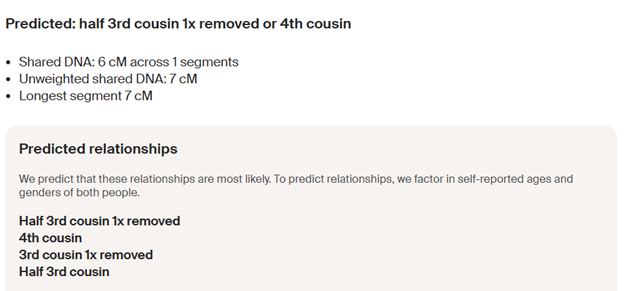
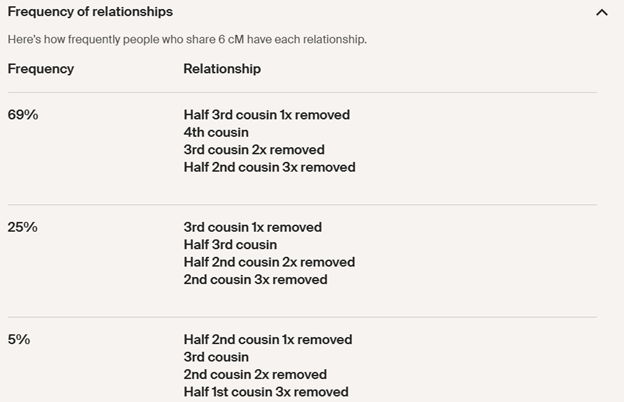
It seems to me they have adopted the “Cinderella Principle” – push hard to fit the data into a desired result. Are they really claiming that 99% of all Matches at the 6cM level are a 4C or closer? The Ancestry folks are much smarter than that… They know better, and, for some reason, AncestryDNA is distorting the truth! SHAME! Our tens of thousands of small cM Matches do not fit into a size 4C Cinderella slipper!!
Bottom lines: still rely on 1C or closer relationships for analysis with ProTools; IMO, beyond 2C, treat the estimates as garbage; let me/us know if you have some insight that I’m missing (other than something related to greed).
[22DD] Segment-ology: ProTools 22 – A Rant About Relationships by Jim Bartlett 20250119
 segment-ology
The relationship estimates have always been a bit suspicious, they’re even more so now. I think ancestry and other testing companies mean well, but the reason we’re in this situation is that they’re calculating the estimates based only on peoples reported relationships. Not many people with a 6cM match are reporting a 8C relationship because very few trees extend that far back – so very few are reported and dont make it into the stats. The vast majority of trees don’t extend much further back than 3rd/4th cousin level, so that’s where most relationships get reported. My suspicion is that testing companies don’t take into account the vast majority of matches, which are unidentified, when they’re calculating the estimates.
LikeLike
George – not long ago I published my own cM stats based on my thousands of Common Ancestors – most well beyond 4C level. My averages were higher that the Shared cM Project, but not significantly. Jim
LikeLike
Pingback: Friday’s Family History Finds | Empty Branches on the Family Tree
23andMe and MyHeritage provide the same inaccurate estimates. At least FTDNA says “4th cousin – Remote” for that 9 cM match.
I am hoping that Steve the Ancestry employee above is correct – that Ancestry is looking for a way to monetize the info that the other sites give for free. At least then there would be hope for getting segment data some day, and Pro Tools gives them the way for the upcharge (which I would gladly pay).
LikeLike
Rich The outgoing Ancestry CEO reports there will be a major improvement announcement at RootTech. I’m on a full court press with ProTools, and hope I will be able to build on that. Jim
LikeLike
I’d give my left arm for Ancestry to announce segment data/chromosome browser at RootsTech. They have looked into Y DNA kit sales recently, too, so that’s a possibility.
LikeLike
Pretty sure I never said I was an Ancestry employee. if I was I’d be the stroppy long haired geek at the back who was always objecting and being ignored !
Just another retired Engineer looking for mathematical certainty in a fuzzy world.
LikeLike
Your exact words were “I have been with Ancestry for about 15 years now and over that time I have seen a marked change in the company.” Hence the confusion about being an employee. No biggie. I’m sure you’re right that money > engineering there.
LikeLike
If I am thinking correctly, perhaps there is some rationale behind the logic of asserting that all small cM matches could rise to the level of 4C. A fourth cousin relationship means that the shared ancestor is a 3rd great grandparent. A pedigree chart shows that there are thirty-two (32) such 3rd great-grandparents. Perhaps not by coincidence, then, Ancestry permits definition of up to 32 DNA groups, each with its associated color. As others have probably already done and are doing, 4C cousins are tagged with the color of the 3rd great grandparent which they share with you.
Cousins with more distant relationships, 5C, 6C, etc. must have a shared ancestor whose descendants include at least one of your 3rd great grandparents. In such cases, assign such distant cousins 5C, 6C, etc. with the color of your 3rd great grandparent who lies on the path to this shared, more distant ancestor. Although imperfect, color coding this way would, at least, show along which branch of the family tree one is related to such distant 5C, 6C, etc. cousins.
In addition, the 4C level is a “wall” of sorts, being associated with 3rd great grandparents. Many Ancestry users may decide that finding one’s 3rd great grandparents is “good enough.” My experience is that the availability of online records starts to drop dramatically when trying to push through this wall of 3rd great grandparents.
As well, the risk of Type 1 error (using DNA to conclude the presence of a shared ancestor when the match is simply due to chance alignment of DNA nucleotides) rises as we move to smaller cM amounts.
Could this, then, be part of Ancestry’s logic in drawing the line at 4C, for all practical purposes?
Best, Andy Howell (HoJo)
LikeLike
Andy, Good feedback. BTW – I think they are up to 64 different Dots (including the star). I’m thinking of using 32 Dots on 32 Ancestor Couples. I don’t worry about Type 1 errors – I use the cMs as flashlights (or laser beams) to fit together genealogy puzzle pieces. I’m beyond 4C now, so the cMs can be all over the place. I’ve actually added a few folks in my Common Ancestor spreadsheet who don’t share *any* DNA with me – but they’ve done great genealogy research. It’s helpful to be able to click on a hyperlink and call up their Tree for reference. My focus is on the genealogy. Jim
LikeLike
I am sure, like you, that there are people at Ancestry that know fine well that the numbers they suggest for frequency of relationship are nonsense, unfortunately thay are not the people in charge. I have been with Ancestry for about 15 years now and over that time I have seen a marked change in the company. It appears to me these days like a genealogy company that has been hijacked by accountants, the people that front the company at RootsTech and the like are genealogists but I don’t think they’re the ones making the decisions.
Now to you and me this is irritating but we can ignore the nonsense because we can recognise it but consider the newcomer to the hobby. For the most part they see Ancestry as “the experts” and believe what it tells them implicitly. In the past on a forum I have been accused, mockingly, of “so you think you know more than Ancestry !” when I have suggested that their relationship predictor is wrong. This leads inevitably to the blizzard of nonsense we get from the hints sytem and the millions of crazy trees that people copy indiscriminately because it’s on Ancestry.
I suppose there’s not much we can do about it except continue to speak truth to power and educate where people are open to it.
LikeLike
Steve – I want to be clear that I’ve been on Ancestry over 20 years, and am happy about virtually all of their tools, records, Trees, etc. For me, they are a valuable resource. For the most part we need to understand what they offer and work around some of the issues. For instance, many Trees have valuable insights and records; many do not and have lots of errors – we have to sort through it all. And with DNA we understand the Ethnicity estimates will be forever shifting. The DNA relationships have a lot of overlap (as does the Shared cM Project); and we have to recognize that we cannot sharpen that marshmallow very much – there is variation in the biology, so there will be variation in the data.
I’m trying hard to pinpoint a specific area that they know is incorrect, and suggest that they could lighten up a little for their customers. The outgoing CEO just hinted at a major new feature to be announced at RootsTech – I think, and hope, it will be a game changer like ProTools. We are getting very close to combining genealogy and DNA in ways that will make Brick Walls almost transparent. Our DNA and Ancestors only fit together one way – and the more puzzle pieces we can place in the overall picture, the easier it will be to finally place the hardest ones. Jim
LikeLike
Jim – You’re easier on Ancestry than I am. I agree they are an immensly valuable resource, but at the same time they are also very frustrating. I would call them the best genealogical company and simultaneously the worst.
To illustrate what I mean about the acoountants being in charge take ProTools as an example. I make the assumption that the vast majority of people are paying the extra for the DNA aspects of this. The extra shared match information we are given, along with other information that we are not yet given such as triangulation and shared matches maternal/paternal side, is all information that Ancestry have always had and that other companies give us in their subscriptions. They could have given us this information any time in the last ten or so years but, in my opinion, have been holding on to it until it could be monetized.
To some extent I have sympathy with them as it must be difficult to maintain a subscription funded company on a product that is naturally limited, the flow of direct ancestors just dries up as we get further back. DNA has added a new game but that also will dry up at some point. I just wish they would impose more rigour on their genealogy while they’re taking our money.
LikeLike
Steve – each company has some pluses and minuses. I’ve squeezed all I could (mainly complete Chromosome segment mapping) from the others and am now focused on the genealogy part at Ancestry. At some point, I’ll cycle back again…. Jim
LikeLike
I cannot add any special insight, except to say I’m seeing the same thing, and this force-fit to 4C or closer seems to be happening at all levels (my example being a 29 cM match to my mother). I’m probably messing w/ Ancestry because I’ve temporarily assigned mom’s DNA to her own mother who died 85 years ago. Even pretending mom’s DNA is her mother’s, the 4C estimates are off.
LikeLike
I am deep into the weeds like you Jim and have had the same observations with distant matches predictions. I’ve had occasions when I can’t even mark the known relationship as distant (no option) which is ridiculous! However, that seems to be back now.
LikeLiked by 1 person
I’ve noticed for a while that Ancestry is skewing all relationships to be 4C or closer, even when the cM are just 6-8cM. By their numbers, 99% of matches in this cM range will be 4C or closer, which does seem patently false. They should give a more realistic probability estimate of 4C or closer, and the probability of “more distant,” i.e., >= 5C. It is so very misleading to suggest that someone who matches 6 cM will be 4C or closer.
LikeLiked by 1 person
Hojo? – Thanks for your feedback. If it’s patently false to you and me, it should be crystal clear to them. That’s what upsets me the most – they know better! The Shared cM Project reports plenty of folks who have found Matches beyond 4C. I don’t think *anyone* at AncestryDNA could argue that only 1% of our Matches are beyond 4C. My question to them is: “why not allow us to tag our Matches out to, say, 8C?” is it because it takes a little more programming and storage? But think of the treasure trove of data if we all did that; if we all helped Ancestry with real data beyond 4C. They could have the GOAT Shared cM data! Automatically (after the programming)!! I know their estimates are incorrect; they know their estimates are incorrect – but the vast number of their customers don’t realize it… SHAME! Jim
LikeLiked by 1 person
Veronica – just think of the opportunity AncestryDNA has lost. We genealogists could provide real data, say to 8C level, that would be the ultimate Shared cM input. Jim
LikeLiked by 1 person
This is an accurate rant. I find I can’t use their estimates at all with only slightly more distant matches. Sorting shared matches using ProTools, beyond the obvious ones, is, as you have noted, very useful for finding trees that may help identify where the match falls, but it’s no help for estimating relationships.
I just ran into a grandparent/parent/child who all tested. Ancestry has labeled the two the parent-child relationships accurately, but couldn’t tell there was a grandparent/grandchild situation and guessed Uncle/niece. (I know I’m off-topic from what they show for more distant matches, where everyone is a 3rd or 4th cousin as you discuss here. But when I ran into it I thought, this is an area where all their analysis should apply pretty easily.) I also note that the relationship estimate while looking at one person of a pair is often labeled differently when looking at the other. (Again, I’m seeing this in closer relationships, in the 2nd cousin range: the ones beyond that I’ve stopped comparing long ago.)
LikeLike
Cheryl. Thank you. After I’ve places all the Matches ProTools has as 1C and closer, I’ve tried going a little deeper: 1C1R; 2C; etc… Sometimes it works, somes not. Once I start down the rabbit hole of building back a Match’s Tree, it’s hard to stop. An estimated 1C Match should show a link by building back to grandparents (not too much work). It usually works for 1C; but at 2C I find myself pushing past great grandparents – and that ususlly begins to be too much work. But I’m stubborn and want to go one more generation – that when I get really annoyed if I *still* don’t find the link. It might be an NPE, but I think it’s getting to be more than that.
I’m confident, and willing to work, out to 1C relationships – I’m adding many new Matches that way. I need to steel myself to moving on, and coming back after I’ve solved all the 1C links… Jim
LikeLike