
In my last post I outlined two insights from analysis of my 8700 Matches at AncestryDNA with confirmed Common Ancestors (CAs): the number of Matches increases dramatically with each generation going back to the 6C level (where ThruLines ferrets out a lot of my cousins); and the average cMs flattens out in the mid-teens beyond the 4C level.
For this post I analyzed the Matches to see the distribution based on shared cMs.
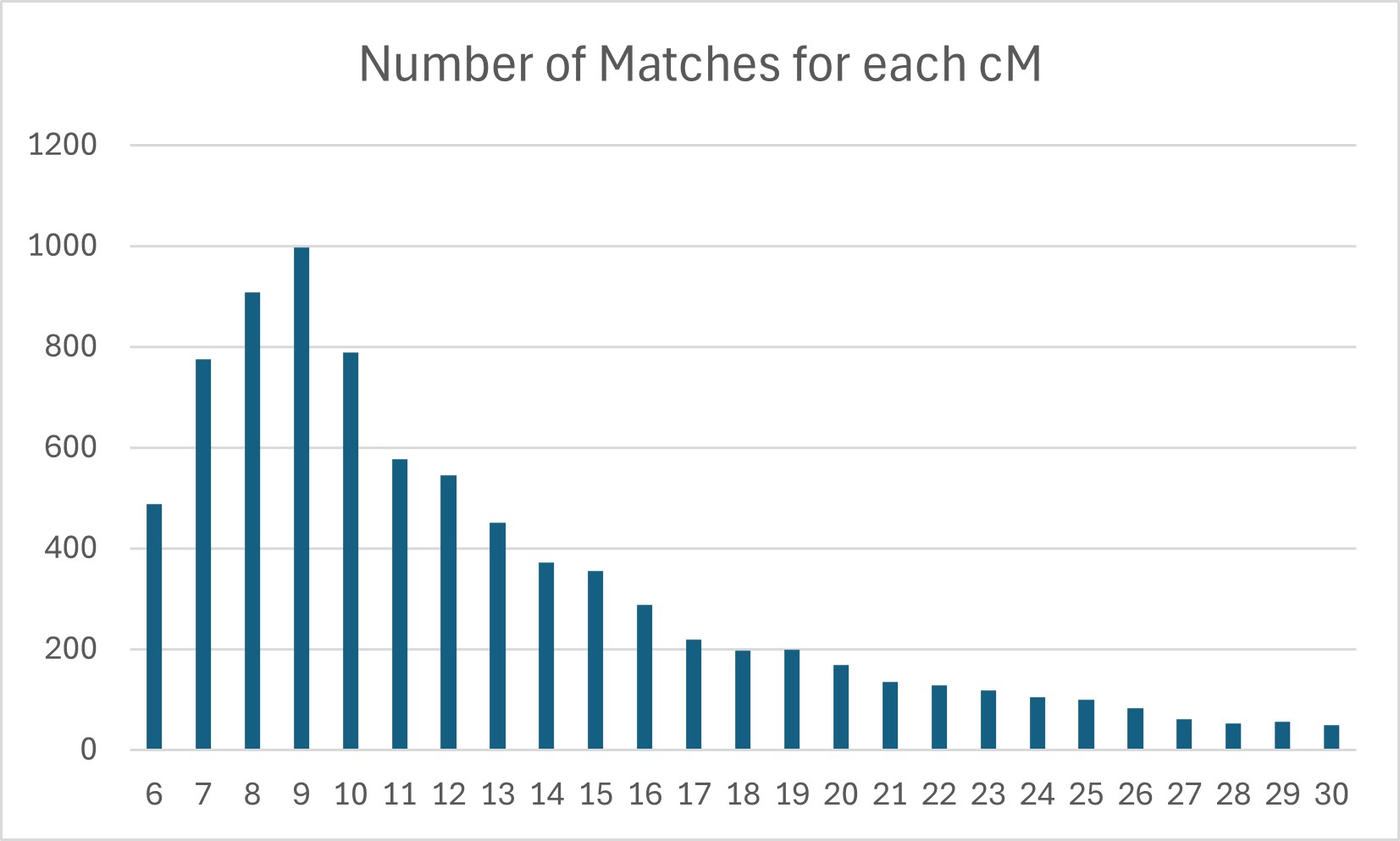
Shown and not shown are 1491 Matches over 20cM, about 17% of the total. But the insight is that 83% of the Matches are from 6 to 20cM. And you can easily see the spike at 9cM. You’ll also notice the Matches at 6 and 7cM which I saved just before the AncestryDNA change in the lower threshold several years ago. I’m not sure there is a drop at 8cM – maybe because I haven’t found a lot of Matches at the 7C level and beyond.
At this point, as a life-long genealogist, I want to reiterate that cousins are where you find them and by far most are under 15cm (what we usually call small segments). And this is just the tip of the iceberg, because most of our true cousins beyond 4C (who have taken a DNA test) do not show up as DNA Matches. Most of my under-15cM Matches are also part of interrelated family groups (per ProTools), and their lines usually agree with standard genealogy research. A small percentage don’t and I remove them from the spreadsheet and this analysis.
Everyone has their own objectives in genetic genealogy. I encourage you to think about yours and write them down. Collecting cousins is not my objective but documenting interrelated cousins in family groups (with ProTools), and building evidence for each Ancestor is. This includes finding a few Ancestors that don’t “look” right and turn out to be NPEs. Or using Triangulated Groups or Clusters or Floating Branches to build evidence to break though Brick Walls/NPEs.
Clearly this is genealogy “big picture”. It forces me to treat all lines and Ancestors equally (yes, after I’ve spent a lot of time on my favorites). However, some of these insights, will also help with “targeted” objectives into specific areas of our genealogy.
[06H] Segment-ology: Insights into Matches; by Jim Bartlett 20260125
 segment-ology
Ciao Jimmy quel gruppo triangolato del tg segmento tra 7,1-9cM cin gruppo balcanici rom due mi hanno confermato che sono rom.
LikeLike
Great news! Congratulations. Your hard work has paid off. Jim
LikeLike
Ma tu Jimmy pensi che se non trovo collegamento con loro ma con triangolazione tu dici che ci sua un no e nella mia linea sud Italy con loro che sono rom e misti rom?
LikeLike
Thanks Jim, these analyses are great.
I have been working my way back up the tree by DNA for some time.
The tiny matches turning up in ThruLines(TM) now are more and more NOT connected the way they suggest. Maybe they are further back on the same line, beyond all our present trees.
Can I sort it with SMs (“SMoMs” at Ancestry)? Sometimes, but only if one of the SMs is already a known match, or a tree gives a clue.
So, what is beginning to happen is that I can’t place tiny matches by SMs and the tester is dissuaded from copying over to somewhere with a chromosome browser where I could place them on a branch.
Because they believe that SMs will solve their needs. For a while, they will.
So for me, the further back the connection might be, the more SMs at Ancestry hide it from me.
For the last year or so, Ancestry has been giving me more cousins in known territory, but not opening up any new land. This is not just stamp-collecting. I find stories in the patterns of movement and behaviour, even if there are no wills to provide that detail. And even more of those stories come from distant cousins.
If I understand you correctly, most small matches do connect, somehow: few are just false. In principle, the new MyHeritage test should illuminate this question, but it will take a few years to gather enough data. If the new test is more accurate, those few false matches should disappear entirely.
Back in the 70s I watched Fred Sanger tell an eagerly listening room about a new DNA test he had devised. We’ve come a long way since.
LikeLiked by 1 person
CHris, Thanks very much for your insightful comments – I can relate to them all! Wow on Sanger in 1970s – I was a Navy LT in Japan and Washington most of that decade – into genealogy, but no clue about DNA until I took a Y-DNA test in 2002.
I study/validate every ThruLine – 2 years ago my experience was 95% correct (discounting “Potential Ancestors); sinxe then it has drifted down to about 90%. I think Ancestry tweaked the TL algorithm a little into “iffy” territory. I’ve seen some that don’t even agree with the Matches’ parents or grandparents… However, some are off by just 1 or 2 generations, and I’ve “fixed” them in my Tree and gotten a new 7C or 8C documented. Because I have so many Matches documented in the Notes, my first chore with a new TL is to check the Match’s SMs to see if there is a clear consensus, or not. I also look at the Match’s closest SMs, and often can add a few more Matches to my CA spreadsheet. Alert: a Match’s parent, etc. may not be on the same line back to the CA…
With unknown Clusters, I use ProTools/PT on closest Matches (down to 100cM or a little lower) to see how they are related (“their” CA). Working down the list, I can often extend their CA more generations. Sometimes I eventually find our CA, sometimes NOT. The NOTs then become floating branches. I’ve found several NOTs that also have a few Matches with TG segments – and the TG segments are usually hanging out with no ancestry beyond a grandparent or so… I believe in TGs and in Clusters pointing to CAs – so these must be pointing to missing Ancestors (usually wives) or NPEs in my Tree. My next big effort will be to try to determine a firm location for each Brick Wall and try to marry those up with the several floating branches I have. I have one such Cluster (I call it 06F36, after a TG that is a solid consensus) with over 300 Matches in it – and so far 3 separate floating branches. They’ve got to split or come together somewhere….
Per my last blog post – the vast majority of Matches are small cMs – well over half of them are True (my glass is more than half FULL) – so that’s where the action is. I rarely get concerned about the cM size anymore, I just work on the genealogy (which is hard to do at the other companies with segment data). Thanks again for your feedback.
Jim
LikeLike
Your science and technology are beyond my brain level, but I believe I am doing the same thing by researching my low match connections as I have done genealogy for many years and have a large extended tree. I am sure there are errors, and I correct as I go, but my dna matches for the most part, and follow my research.
Thank you for stretching my brain. I know that everytime I read your articles I learn something, it might be small, but it is something more than I knew before.
Sincerely Carolyn Leverich Atkinson catkinson54@msn.com ________________________________
LikeLiked by 1 person
Cat, Thanks for your kind, and encouraging – feedback. My goal with Segmentology has aways been to helpfully reach out to genealogists. I’m not really a scientist (but my wife is). I’m an engineer, but I have a little gift for spacial puzzles… This has really helped me understand our DNA from two parents, and how it divides into segments. It *is* hard to keep straight. Jim
LikeLike
Are you a descendant of John Bartlett and Priscilla Faulkner?
LikeLike
Kathryn, No, I’m from the WV BARTLETTs who came from Richmond Co, VA (and probably England before that). Are you from that line? As the founder of the BARTLETT Y-DNA Surname Project at FTDNA, I know about most of the BARTLETT lines. We have the Y-DNA *signature* for 23 different lines. Per Y-DNA, John is a descendant of the Mayflower folks…. Jim
LikeLike
Why the peaking at 9 cM ???
LikeLiked by 1 person
John. Good question!. Well clearly the number of Match/cousins increases with each generation going back. Notwithstanding that the amount of shared DNA will decrease with each generation – by a factor of 1/4 for each generation. So the battle between increased number of cousins vs the decreased amount of shared cM continues… However, I *believe* (I’m an engineer, not a scientist) that we do have many more 7C and 8C and beyond than we are actually figuring out. Real cousins who share at least 8cM (the current threshold at AncestryDNA) are out there, but they are 7C and beyond, and ThruLines does not pick them up. That’s one issue to explain a drop off below 9cM.I have gone through my Common Ancestor spreadsheet – Match by Match – to: 1. reevalute the genealogy; 2. add the path & Match to my Tree and Tag them as a DNA Connection at AncestryDNA, and 3. evealuate all of their Shared Matches with ProTools which lets me add more Matches that ThruLines misses. I am currently on row 3325 (of over 10,000) and at the end of my 5C Matches. The end of my 6C Matches is a row 6583 – so a lot to go… all the ThruLines are accounted for, but I’m confident my review with ProTools will add more. And at the 6C level many will be 6 to 8cM Matches – we’ll see. If, after all of that, there still remains a 9cM high point, I’ll conclude that the negative “1/4″ factor” overtakes the “positive increase of cousins” factor. I have some amount of missing data which should be included for an apples-to-apples analysis. Again… we’ll see. Jim
LikeLiked by 1 person
Ok, I see your reasoning. I think you are more of a scientist than your nature will easily admit … 🙂
LikeLiked by 1 person
Kevin.ieri hai detto e ora di passare alla genealogia per questi matches che formano questo tg sul chromosome16 in che livello potrei cercare?con questo piccolo segmento triangolato tra 7,1-9cM che aumenta ?
LikeLike