
Initially a genealogist will generally focus on their closest Ancestors and relatives. But once those have been documented, it’s time to expand our goals and efforts to more distant Ancestors and cousins. Remember that even at close 3rd cousins (3C), roughly 10% of them will not be a DNA Match. They may share a little DNA, but below the threshold to be classified as a Match. This grows to about half of all true 4C; and most of the true 5C and beyond. The point is that the true 3C to 8C that we do find may well share only one small DNA segment with us. Don’t be afraid of that outcome – welcome it! As a long-time genealogist, every relative is important to me. Each one has the potential to have new information I’d like to see: records, pictures, stories…
I document my Matches with Common Ancestors in a Spreadsheet (see Chapter 7 in Segmentology Fundamentals). I now have roughly 10,000 such Matches from all the companies (heavily weighted at AncestryDNA due to ThruLines). I recently sorted that spreadsheet by shared cMs and made a graph.
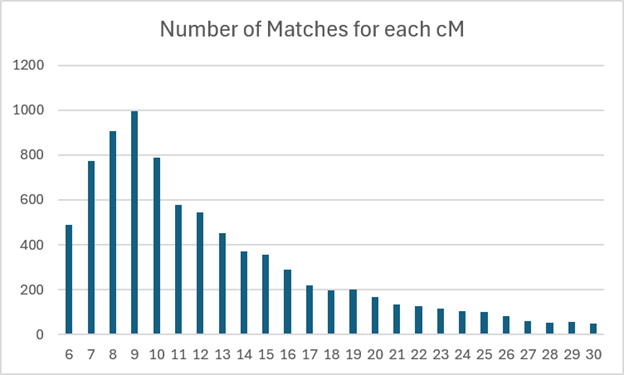
The takeaway is that if you use 20cM or 15cM as your lowest threshold, you are ignoring a lot of your true cousins.
Don’t be a Small Segment Scaredy Cat! Maybe the small segment is false, maybe it’s true. So what? The prize is a new relative.
Originally drafted for Halloween, but I got distracted….
[06J] Segment-ology: Don’t Be a Small Segment Scaredy Cat! by Jim Bartlett 20261104


The 5.5 cMs with my husband is made of of smaller segments to total 5.5. I cannot find that just now. Please tell me why a 5.5 cMs is often a false segment.
LikeLike
eandm, Multiple segments adding up to to 5.5cM is almost certain to be mostly, if not all, false. Here is a good experiment to try. At GEDmatch select a Match who only shares one segment, and look at it on the Chromosome Browser (check on the color codes). Most of the Chromosomes will be a combination of yellow and red vertical lines – about 700,000 of them. Only one place on one Chr will show a “shared segment”. You may have heard that you and I will share over 99% of our DNA, but it’s mostly very short pieces of DNA – like the DNA I got from a Neanderthal ancestor. Experience has shown that shared DNA segments 15cM and larger are virtually always true segments (from a Common Ancestor). As we drop down from 15cM the likelihood that it’s from a CA starts to drop off – the shared segment is considered false. Roughly, when the shared segment gets down to 7cM it’s found to be true only half the time; and below that point, smaller segments are false most of the time. One of the ways this is determined is with parent/child comparisons with a Match – if the child has a Match, but neither parent has the same Match, the shared segment is false. The companies generally don’t report segments below 7 or 8cM. A 5.5cM segment would never be accepted on its face to be True; and 2 or 3 segments that add up to 5.5cM would virtually never be used. Hope this helps.. Jim
LikeLike
Thank you; and I now understand your espousing small segments. You are talking about 1 total small segment, and NOT a series of small segment that then make a small segment like my 5.5 cMs wih my husband. May I say at Ancestry I have a big bunch of 6 cMs matches with TREE MATCHES. I think I captured these years ago before they discontinued 6 cMs matches at Ancestry.
LikeLike
Jim, the percentage of NPEs increasing. Yes! Since I am anonymous here, I will share 3 NPES who popped out of 4 children. My mother and father were married and living together and had 4 children. Dna has proven my “father” only fathered the first child, and the man up the street, fathered the last three. Yes, I was shocked! But, it did not define Me, and my humanity. I did nothing wrong. I am 83 and have seen a lot of drama. This is LIFE.
LikeLike
I’ll add: in my free book, Segmentology Fundamentals, Chapter 2 is devoted to YOUR DNA segments – all are true. Chapter 3 is about SHARED DNA segments (formed by a computer algorithm) which can be false under 15cM. Jim
LikeLike
I’m not against working small segments, but most trees – including my own – are not very reliable beyond 3GG or 4GG ancestors. I won’t assume that the name of some fictional person who coincidentally appears in both trees, my own and that of the DNA match, proves the ancestor. Virginia has great records, but upstate Georgia and South Carolina, for example, don’t always have the needed depth. Isn’t it necessary to have a solid tree based on documentary evidence that goes back a sufficient number of generations, before attempting to work small cM matches that come from ancestors beyond the brick wall? Best, Andy
LikeLike
Documentary evidence? I am always concerned about the non-paternal events and the percentage of those events.
LikeLike
eandm – What’s your (personal) best guess for the percentage of NPEs? I think it’s increasing…. Jim
LikeLike
Andy, Great question! Answer: yes and no… haha. From a genealogy point of view we’d like to have solid documentary evidence. But as you point out, that doesn’t always exist. However, DNA provides powerful tools. We use DNA to find killers, to identify human remains, etc. Having done a lot of work with Clusters and Segment Triangulation, I’m now certain that they are powerful “pointers” to Common Ancestors – which applies to Matches without any Tree or to Adoptees and NPEs – we are now confidently finding them all the time. My work, so far, has convinced me that these grouping techniques *are* reliable beyond 4G grandparents (6 generations back; 5C level). Granted, it gets harder with each generation. And, at the end of the day, we’d like to have some name, from some record, to identify the Ancestor.
The way you worded your question is almost like a trap… but nevertheless, I will argue NO. I have several cases without a clue as to who was on the other side of a brick wall – I developed Clusters and Triangulated Segments that pointed to *and through* the Brick Wall and then found strong consensus among those Matches as to the Ancestors on the other side. I have one Ancestor (of a friend) who is a tic mark in an 1840 census – we know the parents, but no record of his name so far. Another case of an unnamed mother who died tragically, and all the children named their first born daughter “Susan” – good enough for me – and then close to 100 Matches in a TG and in a Cluster, with over half having Trees with the same surnamed Ancestor: CUMMINGS. Both of these cases festered for decades with no genealogy progress. I’d agree it’s best to do as much genealogy work as possible, but it’s not a necessary prerequisite for proceeding. IMO, Jim
LikeLike
Jim, in regard to your enthusiasm about small segments, my experience agrees with yours. My issue is that Ancestry’s ThruLines has used wrong trees to connect wives. The men are OK (Y-DNA gave me my 3ggf’s brother). The problem is what ThruLines has done to their wives, both named Sarah. ThruLines used “bad/no no research” trees to force the brothers’ wives into being sisters named Sarah (with wrong parents). I don’t know how to use small segments to pull the women apart and identify their own small segments. What I have: I’m in a Gedmatch Ancestor Surname Group attached to a Facebook workgroup, so I have access to a few of these Y-DNA cousins’ AncestryDNA-to-Gedmatch segments. Some of those researchers have AncestryDNA accounts so I use the triangulation feature with their trees. I no longer have access to my FamilyTreeDNA acct. We know the county the brothers grew up in and likely married before moving along in different directions. I have explored those neighbors’ surnames in the brothers’ Ancestry triangulations. I can’t see to use that DNA Matrix. Can you give me a starting point for tracing who these two men’s wives could descend from? Should I begin by asking each Ancestry tree’s owner to remove who they have for a wife? Asking the many hundreds of tree owners to share their AncestryDNA results with Gedmatch? Even if I did that, what would the next step be?
LikeLike
Donna, I love ThruLines – it’s sort of like AI doing a lot of the bone-weary work for me and presents a tight bundle I can focus on. About two years ago, I did an analayis of the thousands of ThruLines I had and, based on my own research, found TL to be over 95% correct. That’s gold – my research was now focused and my time more efficiently used. Over the past year or so, I’ve seen TL “stretch” a little more in it’s zeal to give me more TL. The error rate (based on my own checks) dropped from less than 5% to around 10% – still pretty good, and “worth it” for me. However, in the past few months, I’ve seen “slop” start to build up: TL doesn’t even overlay with the Match’s Tree, it accepts VA couples getting married in New England; creates children not in the census records; accepts input from some wakadoodle Trees (you know the ones with 25 children with repeated given names, and junk like that). I’m now shifting to Pro Tools to find close relatives to Matches I’ve already adjudicated (often Matches with no family Tree (NFT) or Unlinked Trees which Ancestry won’t look at (and rightly so))
To your issue. I believe Triangulated segments, down to 7cM or so, are virtually all true segments. And each one of your Triangulated segments comes from a specific Ancestor, down a specific path (of your Ancestors) to you. Flip this picture, and we have a Triangulated Segment in you, which had to exist in one parent, one grandparent, one Great grandparent, etc. going back. When we find out how Match-1 is related to us, it almost always goes back to a Common Ancestor COUPLE (a father and a mother; usually husband and wife). We cannot tell which one of this couple carried that segment – but it *was* just one of them. To figure out which parent, we have to find a Match-2 who is a known cousin another generation back – either though the mother or father of the Match-1 Ancestor couple. The other key concept here is that most of our Ancestors (in a genealogy time frame) will have multiple segments that get passed down to us. Think it out… I have, say, 400 specific segments that account for all of my atDNA. Each of my parents would have roughly 200 of them; and each grandparent would have rougly 100 of them… you get the idea. In your case find several TG segments that go back to your target couple. Roughly half those TGs will continue back on the male side, and you’ll see those TGs in more distant cousins with his surname. The other half of the TGs will go back on the female side and show up in her parents as a Common Ancestor.
Hope this helps, Jim
LikeLike
Since I share a lot of small segments totally 5.5 cMs, I guess I am related to my husband. I have not found it in either of our robust trees; but as I was told earlier on, seems it could be just a small population pool with dna swirling around.
LikeLike
eandm; I have heard the “population pool” concept of DNA before. It is true that much of our DNA is the same – we get a heart and a brain and two legs to stand on, etc. Plus a whole range of things to let us grow and stay alive. But at the end of the day, we get 23 chromosomes directly from each parent – no other source. None of our DNA comes from the drinking water, or the air we breathe. We don’t ladle our DNA from a swirling soup pot – it only comes from our two parents. This is why I like segment Triangulation and Chromosome Mapping so much – they let us “see” which Ancestors contribute which amounts. My feeling is that saying our DNA is from a “pool”, that’s just a cop out that lets us off the hook to figure it out. Like in genalogy when we say “that Ancestor is from Ireland” which gives us “permission” to quit researching them. Anyway, it’s just my viewpoint… Jim
LikeLike
The population pool concept came from the former owner of FTDNA, Mr. Greenspan? I have always thought about that. I cannot find a CA for my husband and me, sharing 5.5 cms total, but his surname/ancestors are documented to be all over the area where some of my ancestors existed and married some of my ancestors’ cousins but none of his people married my people directly. I believe you you could be correct
, I have just not found our CA yet.
LikeLike
eandm, Two things. Bennett is Jewish and that does mean a tight population “pool” to draw from – it shows up as a big, unhelpful, Cluster. Also, have you used GEDmatch (or FTDNA) to from a Triangulated segment around the 5.5cM shared DNA segment? A 5.5cM shared segments is often a false segment…. Jim
LikeLike
Ciao Jim si io delle corrispondenze dna su mhyeritage piccole ma triangolate e corrispondenze con piccolecM soglia 8cM e più fino a 23,3cM con un segmento due segmenti e uno con tre segmenti ho una triangolazione e alcuni di loro sono cugini tra primo e fino a terzo grado tra di loro la maggior parte sono rom e misti rom ma io non so come sono collegata poi queste piccoke corrispondenze abbiamo io e loro altre 18 corrispondenze condivise tutte sullo stesso segmento.
LikeLike