mtDNA is passed from a female Ancestor down the all-female line to each of us. A Triangulated Group (TG) DNA segment is passed down from an Ancestor to us. The concept of DNA being passed down a specific ancestral line – from an Ancestor to us – is the same. Such is also the case for Y-DNA – it is passed from an Ancestor down the all-male line to a man. In the case of mtDNA, the ancestral path is all females; in the case of Y-DNA, the ancestral path is all males; but in the case of atDNA, the ancestral path can zig-zag between male and female Ancestors. Any of our Ancestors could pass an atDNA segment down to us.
The point is the TG segment is found only on one specific ancestral line (like the mt or Y line). However, it is still a genealogy task to figure out which line. As we “walk the segment back” from our own DNA back up our ancestry, there are only two options at each generation. If we know a TG segment is on our maternal side, the next generation back must be one of the maternal grandparents – and so on.
Just as we use mtDNA or Y-DNA, looking for a someone who shares that same DNA with us, to find our Common Ancestor; so, too, we understand that our atDNA Matches in a TG (thus sharing that same atDNA with us) will have a Common Ancestor with us.
This is just another way to think about our DNA segments – they are just as focused as the mt or Y on *one* ancestral line.
[22BX] Segment-ology: Triangulated Group Segments Are Like mtDNA TIDBIT by Jim Bartlett 20230728
Here is the set up for my BROWN story, without dragging the reader through the whole back story. This line includes most of the descendants in the BROWN Y-DNA Project Group-40.
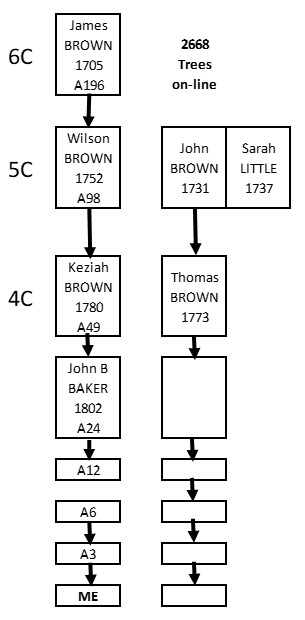
I’m searching for the children of Wilson BROWN (he probably had 10 children, only two daughters are known). This is my Tree at AncestryDNA. I expected ThruLInes to find some Matches… Nada. I had Matches from Keziah (and her husband Elliott BAKER) on down. I had none from Wilson – not too surprising because no one has any Trees for Wilson (except for daughter Keziah). I expected some 6C Matches from James, because I know they are out there – but… nothing.
So I used my “Search on a Surname” process [here] – I searched for the BROWN surname, and checked each Match’s Tree for likely families. One family that quickly became the standout was the family of Thomas BROWN 1773 married Nancy LITTON. I was getting a lot of “hits” on that family. So, I looked them up at Ancestry – there are 2,668 Trees for that line! Almost everyone who shows his parents, has John/James BROWN b 1731 MD; married 1755 Plymouth, MA; d VA & Sarah LITTLE b 1737 VA; d 1779 VA.
Two key points about Thomas BROWN 1773:
1. I have found over 70 Matches who descend from Thomas BROWN b 1773 (shared DNA segments from 10 to 30cM). These are spread over virtually all of his children.
2. Two descendants of Thomas BROWN 1773 – through different children – have taken a Y-DNA test and are in BROWN Group-40. So, Thomas BROWN 1773 is BROWN Group-40. No one else in Group-40 has claimed descent from his father, John BROWN 1731.
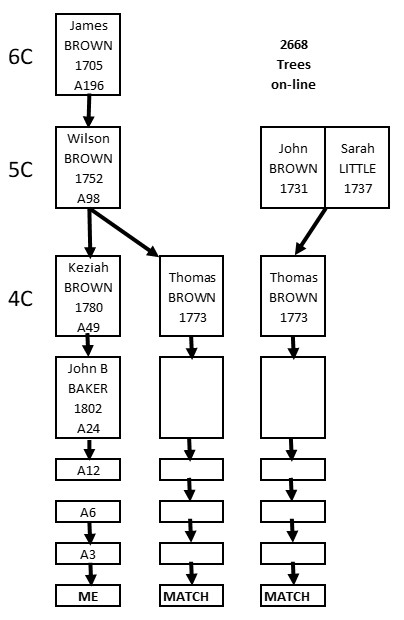
I have concluded that Thomas BROWN 1773 must be a son of Wilson BROWN and so I added him (and his children) to my Tree. I stand alone in doing so…
I waited over a month for Ancestry’s ThruLines to show me the 70 Matches I had found – nada. Disappointing… Ancestry clearly had Thomas BROWN 1773 locked onto John BROWN 1731. I’ve written at least 10 blog posts about the power and usefulness of ThruLInes – search for links to them in the Segmentology Outline [here]. One post is about ThruLines X-Ray vision looking into Private Trees…
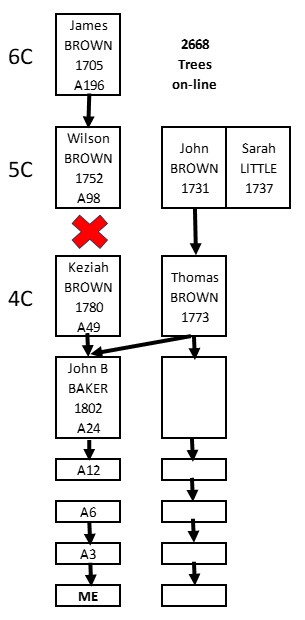
So, I decided: maybe Ancestry is correct! Maybe if I accepted their version, ThruLInes would report some of my DNA Matches as cousins. So, I changed my Ancestor Keziah BROWN from the daughter of Wilson BROWN to the wife of Thomas BROWN 1773 (so the two of them looked like the parents of my ancestor, John Brown BAKER – almost like Thomas had an affair with Keziah.)
The next day Ancestry listed 31 new ThruLines Matches (spread from 6 to 30cM) – all descending as half-cousins from Thomas BROWN 1773 – WOW. All of these were new to me. 2xWOW! Near the top of the list was a Match with a Tree with only 2 parents, and 3 grandparents – ThruLines built the Tree back to Thomas 1773. I have built a lot of Quick&Dirty Trees in my BROWN searches, but I would not have tried that one. 3xWOW! And another Match had a Private (but searchable) Tree. I’d never have found that one. 4xWOW!
The fact that I adopted the on-line version of BROWN Tree does not detract from my goal: find more DNA Match cousins from Thomas BROWN 1773. And ThruLines delivered.! The Matches share DNA with me (no matter how the Tree is drawn).
I still need to put all of these in a spreadsheet; make sure they are reasonable; figure out the averages and see how they compare to the Shared cM Project. And I’ll wait a few more days – fully expecting another tranche in the next day or two.
BOTTOM LINE:
This method will sure save a LOT of scrolling through all the thousands of 8-9cM Matches for BROWN Matches (it took me over a Month of steady focus to just get through the 10cM BROWN Matches). And it will find cousins with Private Trees and cousins with very small Trees that don’t have BROWN in them!
[22BW] Segment-ology: Getting ThruLines to Work for Me TIDBIT by Jim BARTLETT 20230707
I contend that segment Triangulation will identify most of the false shared DNA segments reported from your DNA test. This includes a Match with one segment which is false; as well as a Match with multiple segments, some of which are false. I have Triangulated DNA segments at FTDNA, 23andMe, MyHeritage, and GEDmatch, and found many false segments (segments which did not Triangulate with other overlapping segments). In almost all cases these false segments are under 15cm. I cannot guarantee that all the false segments can be identified this way, but I am confident that most can. Triangulation is a time-consuming process – starting with a download of all your segments from one company at a time; sorting them by Chr and Start, and then working down the list to see which ones Triangulate. I did a blogpost using MyHeritage as an example for segment Triangulation: https://segmentology.org/2020/12/29/triangulating-your-genome/
Warnings: this takes weeks; there are some Triangulations that are difficult – just skip over these; a few might slip through the cracks; there may be some bare spots in your DNA.
Special Note: Although a Match’s segment(s) may be false, that does not mean the Match is not a cousin. This looks like a double negative, so let’s phrase it this way: a Match may be a cousin and not share any DNA segment with you, or they may share a false segment with you. In fact, about half of your true fourth cousins (4C) will not share a DNA segment with you.
Recently, at the Genetic Genealogy Tips & Techniques facebook group, there was a post looking for ways to identify Matches at MyHeritage which are random junk. Segment Triangulation would identify a lot of false segments. However, at MyHeritage, it might be efficient to just download all segments, focus on those below 15cM (where most false segments would be) and work down the list to see which Match segments don’t have a TG Icon. Still a lot of work… If anyone tries this, please post about your experience – we can learn from each other.
[22BV] Segment-ology: Identifying False Shared DNA Segments TIDBIT by Jim Bartlett 20230618
I have long been a proponent of segment Triangulation (and Triangulated Groups (TGs)) and also Shared Match Clusters. Both of these are powerful tools. Both TGs and Clusters group your DNA Matches who share the same Common Ancestor (CA) with you.
But this is just a means to an end. By themselves these groups (TGs and Clusters) do not magically name an Ancestor, they point to a specific, but unnamed, Ancestor. They are just groups of Matches. We must also use genealogy!
By analyzing the Trees of Matches in a TG or Cluster, we can often find a consensus Ancestor. This Ancestor may be a known ancestor, and the Matches’ Trees may provide additional information for our research. Alternatively, this Ancestor may be a new Ancestor for us – a bio-Ancestor, a Brick Wall Ancestor, or even a “floating” Ancestor (unknown connection to our Tree). Or perhaps a fluke, a coincidence, a curve ball from our DNA Matches. Although a fluke is possible, as you research this new “ancestor” more, it either becomes more and more probable as your Ancestor, or less and less likely. In my experience, the evidence usually starts to mount . In only one instance for me did it pretty quickly fall flat (and in that case, I found a “secondary” consensus Ancestor in the group which worked out). As usual, treat this “consensus Ancestor” as a good clue.
Another way to frame this is: TGs and Clusters are good tools – more genealogy work is needed to make them useful – to find out more about your Tree.
The point of this TIDBIT, is that forming TGs and Clusters are good processes, but they are only a means to an end. IMO, they are definitely a step in the right direction, but the research journey is not over with that step. We need to take the next, genealogy, steps of analyzing the groups to find the CA and then integrating that information into our own genealogy.
BOTTOM LINE: TGs and Clusters are a good step – analyzing these groups is an essential next step.
[22BU] Segment-ology: A Means To An End TIDBIT by Jim Bartlett 20230611
I have just updated the Outline of Segmentology. This is located in the black bar in the header of every page – just click it. The posts over the years have jumped around; the Outline tries to put the titles in some order – sort of like a Table of Contents. Each one is hyperlinked to the blogpost. This Outline provides an easy way to scan through the topics and blogposts and navigate to the ones that interest you. Don’t forget to read the comments and questions for each blogpost – they often contain additional information.
[00] Segment-ology: Segmentology Outline Updated by Jim Bartlett 20230604
Bottom Line Up Front: Filter your AncestryDNA Match list by cMs when your objective is a distant Ancestor. Also use Side and Surname filters to further reduce your Match list for review.
Most of us use the Shared cM Project to look up the Shared cMs of a DNA Match to see the possibilities of our relationship. We’ve learned that 3,500cM means a parent/child relationship; 2600 cM is a sibling; 1750cM is a small group of close relatives; 880cM is often a 1st cousin (1C), or other close relatives. And we understand that as the shared cMs get smaller, the range of possible relationships expands.
But we can use the Shared cM Project in the opposite way – what is the probable shared cM for a given relationship? We see narrower ranges for close relationships, and fairly wide ranges for more distant relationships. However, even though the range may be relatively wide for distant relationships, the average cM does shift down as the relationship gets more distant. For example, a 3C relationship would not have more than 234cM; a 7C would not share more than 57cM (and the average for a 7C is 14cM).
Suppose we are focused on a particular Ancestor in our Tree. Our Target could be a brick-wall Ancestor; or a potential NPE (Not the Parent Expected) Ancestor; or a suspicious Ancestor; a known Ancestor for whom we’d like to find a new cousin who has some in-depth knowledge of that family; etc. We can use the Shared cM Project to narrow down our search! This works for close relationships as well as distant ones – my focus here is on the distant ones, but the process is what is important.
A good site to use the Shared cM Project is at DNAPainter: https://dnapainter.com/tools/sharedcmv4 – this site provides a number of interactive tools along with the basic Shared cM chart. For example, a 5C relationship (back to a 4xG grandparent – we have 64 of them) would average 25cM – and 50% of them would be in the under-20cM range. In this case we might want to start with the 50% in the over-20cM range. But for a 6C relationship (for 128 of our Ancestors) the average is 18cM and 70% of the Matches will be in the under 20cM range. Each of us gets to pick our own objectives and projects to pursue. If yours is like many of mine and beyond the 5C range, working within a range of cMs may be helpful.
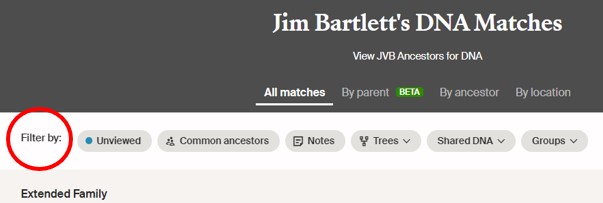
Here’s how. At AncestryDNA, open up your list of Matches, and look at the row of “Filtered by:” tabs – we can use many of these in combination.
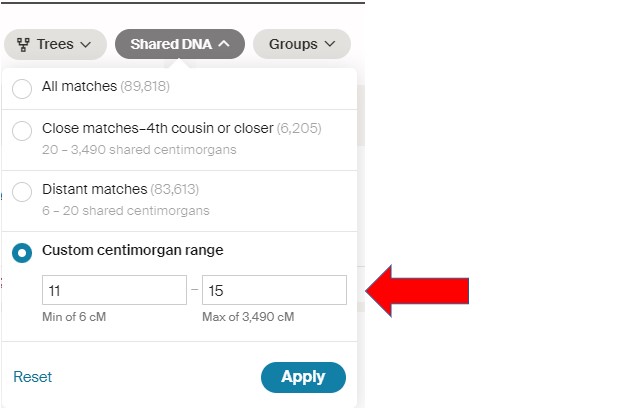
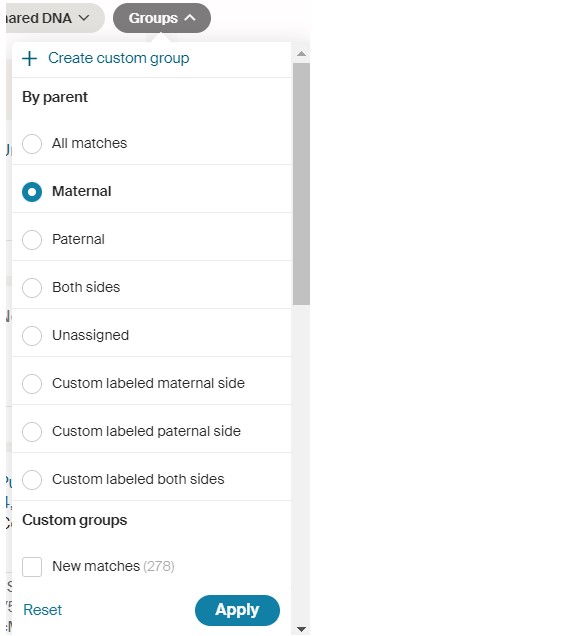
For this example I’m going to use the Shared DNA tab to select a range of cMs, AND the Groups tab to select my Maternal side.
In the project I’m working on, I’ve already looked at the Matches down to 16cM. By selecting a range for the next search, I also speed up the time for AncestryDNA to produce my filtered list of DNA Matches. In this case I’ll be looking at 11cM to 15cM. Remember to Click on Apply!
I’ll also filter my list by using the Groups tab to restrict the list to only Maternal-side DNA Matches:
In this case, I’ve chosen the Maternal side (remember to click on Apply). This will filter out a lot of Matches that don’t really apply to my Target Ancestor [I can later select the “Unassigned” Group to check those, too.] Note that you can ALSO select several categories under Custom groups – such as New Matches (especially helpful if you want to revisit this project at a later date to check on new Matches), and/or any of your “dotted” Match categories (not much help in my current project because I’ve already visited – and dotted – all of those Matches I could determine, and I’m looking for new ones now in the under-20cM range.) In some projects, this “dotted” filter may be valuable.
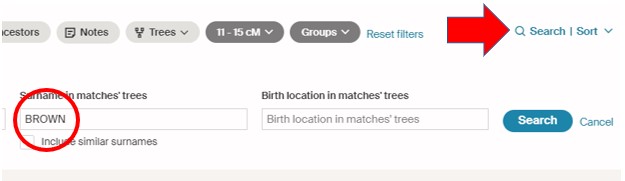
And there is one more filter I often use. For my current project, I am looking for my DNA Matches who have a BROWN Ancestor. So, I click on the “Search” tab, which brings down a row of options. I type BROWN into the “Surname in matches’ trees” search box:
You can decide to check the “Include similar surnames” box, or not. For this project, I got plenty of results with just BROWN, and, if I wanted to, I could go back and try BROWNE or BRAUN, etc. I’ve had mixed results with the “Birth location in matches’ trees” filter box – sometimes the result is either the surname or the location, and I’d be wanting both. I did have very good results on a project with HIGGINBOTHAM surname and Amherst County, Virginia location. You might need to try some combinations to see which works the best for your project. Remember to click on the blue, highlighted Search box to include this filter.
This process of filtering is a powerful way to shorten your list of DNA Matches, tailoring them to your project goals. The addition of a cM range has helped me focus on more distant Ancestors and to speed up the AncestryDNA listing algorithm.
BOTTOM LINE: When you are searching for DNA Matches, think about the best way to combine the filters (including a cM range) and search parameters at AncestryDNA.
[22BT] Segment-ology: Using the Shared cM Project in Reverse TIDBIT by Jim Bartlett 20230601
Bottom Line: We cannot tell from a single Match; but there are at least three ways to figure it out.
SETUP: One cousin, or even several cousins, who share a Most Recent Common Ancestor (MRCA) with us. The “Common Ancestor” is really a Common Ancestor “Couple” – usually a husband and wife. You descend from one child of this couple, and the matching Cousins descend from one or more of their other children. The question comes up, which parent passed down the DNA segment to us? From this data, we cannot tell which parent passed down the DNA. All we know is that one or the other parent passed it down. I know of three ways to figure this out – maybe you know of additional ways…
1. Grouping *to* the parents’ parents. One DNA Match-cousin back to the MRCA won’t do it. We need a group of Matches – at least one back to the MRCA, and other Matches – often with smaller shared segments – that go back another generation. The group can be formed via Clustering (grouping Shared Matches); or segment Triangulation (or DNA Painter). The goal is to find a Match in the group who is a cousin at least one generation farther back than the MRCA. This will almost always tell you which side of the MRCA the DNA came from. Note: there is a very low chance, this might not work, but finding more than one more distantly related cousin on this line adds insurance. It is best to do this with segment Triangulation which represents a single DNA segment going back, but Clustering works, too. As you find more and more Matches with the MRCA, eventually (with smaller cM segments) they will break into two groups, one for each parent in the MRCA. Each of these groups will be based on a different DNA segment (a different subset of a Triangulated segment, involving smaller shared segments).
Note this is really a subset of Chromosome Mapping, and/or Walking the Ancestors Back.
2. Different partners. If one of the parents had children with a different partner (married or not), and the other Matches descend from this other partner, then you know the shared DNA segment had to come from the Ancestor who had multiple partners – the same DNA could not have come from different partners.
3. Differing ethnicities. If the two parents in an MRCA have very different ethnicities overall (or you can tell the ethnicity is different for this specific shared DNA segment (usually a TG segment), then a review of the Matches’ ethnicities might indicate which one passed down the DNA.
As with many things in genetic genealogy, the DNA may throw you a curve ball. I’m old enough to remember the Mickey Mouse Club on TV – and the “anything can happen day”. As you continue on your genetic genealogy journey, the evidence will mount. It should all point to the same results – which match your unique Ancestors and DNA segments.
Feel free to use this blogpost as a way to answer this recurring question on-line.
Amended slightly to call out the different partners as one of three ways.
If you have a favorite method of figuring this out – please post in the comments.
[22BS] Segment-ology: Does the DNA Come from the MRCA Father or Mother? TIDBIT by Jim Bartlett 20230515
1: One is the MRCA is really a couple – and both your and your DNA Matches descend from this MRCA (couple). You descend from one child of the couple, and your Matches descend from other children of the couple. We may not know which individual in the couple passed down the DNA we share, but we do agree it’s from one or the other.
2: The other discussion is that the child of the couple that you descend from had to have the DNA segment and is then *the* MRCA (singular). But, at least in my mind, this MRCA (singular) is not the MRCA of the Matches, and things get a little complicated trying to have a discussion among the Match-cousins. The various MRCA (singular)s are not “common” to the various Matches.
In Segment-ology, I use MRCA to mean MRCA (couple). This couple is common to Matches who descend from them.
[22BR] Segment-ology: How to Define the Most Recent Common Ancestor by Jim Bartlett 20230513
Small-segment Matches (<15cM) with conflicting Shared Matches (no consensus) are probably false.
This Observation/Theory comes from two directions:
1. Science and observation tells us that (A) almost all Shared DNA Matches (Matches) >15cM are true; and (B) to varying degrees, some Matches below 15cM are false. There is a distribution curve which has a small percentage of 14cM Matches as false, down to about half of 7cM Matches are false and larger percentages of even smaller segments are false. It’s hard to sharpen this marshmallow of data, so please grasp the overall concept that as the cMs decrease below 15cM, the percentage of false Matches increases to areas where most Matches are false. And don’t be confused – you can have a true Common Ancestor with a false Match – it’s just that there is no DNA link (or “proof”). In fact, most of our true 4th cousins (4C) and greater will not be DNA Matches at all. Another point is that there is no such thing as “partly true or false” – the shared DNA segment is all true (from a Common Ancestor) or all false (not from a Common Ancestor). Please don’t go down the “rabbit hole” that *part* of a small segment may be true – we are already down to small segments, even tinier segments aren’t a step in the right direction, unless you have a very, very special case. Not the thrust of this blogpost!
2. My observations of Matches under 20cM shared segments as I search/analyze this huge group (80,000) for Matches with a BROWN Ancestor – also a huge subset (thousands) of my under 20cM Matches.
Background 1: I’ve done the “homework”. Using the Walking-The-Clusters-Back process (starting here), I was able to identify hundreds of Clusters to specific parts of my Ancestry. Almost all to a parent; 98% to a grandparent; roughly 90% to a Great grandparent; etc. out to some that were tagged to 7xG grandparents (8C level). Overall, I have in my AncestryDNA Notes for almost all over-20cM Matches, *some* indication of their line in my Ancestry. Most of these have also been tagged to specific Triangulated Groups (TGs). Part of my analysis of the under-20cM Matches is a check of their over-20cM Shared Matches. Most have some Shared Matches. Sometimes, an under-20cM Match will have many Shared Matches in consensus – most in the same Cluster or TG. Sometimes they will not.
Background 2: My BROWN Project. For this project, I filter my Match List by Maternal (the side for my BROWN line), a cM range (ie: 12 to 13cM); and the BROWN surname. I then look at each Match, and put something in the Notes box…
Background 3; Keeping Track.
[“Good” Matches] I’ll add (ie: impute) the Cluster/TG to the Notes for each concensus Match. Note: some of these will be a consensus on the BROWN line; some will be a consensus on some other line. I also add a Note about the oldest BROWN I’ve found for each of these Matches, if it’s likely to tie to my BROWN line – a judgment call.
[When I’m finally done ferreting out all of these lines in a consensus BROWN Cluster and/or a good probability of a link to my Tree, I’ll look at the number of Matches in each family group, and really dig into the research – this is sort of like collecting clues in Quick-and-Dirty Trees to see what’s worth pursuing.]
[“Iffy” Matches] Some Matches don’t neatly fall into the Good or Bad category – I look at them and usually build their Tree back far enough to determine if a tie-in to my Tree is possible – judgment call.
[“Bad” Matches] I add a Note to Matches with no Shared Matches: ”SM:0”. And I add a Note to Matches with various, conflicting Shared Matches (often on both sides): “SM – var”.
Observation 1: Research/Tree building for Matches with “SM:0” and “SM – var” Notes almost always went nowhere. They had a BROWN Ancestor (a search filter), but their BROWN Ancestor was from England or Scotland or New England, etc. Clearly a very low probability of linking to my BROWN line in Colonial VA. For these Matches I added “X BROWN” in the Notes to remind me they’ve been looked at and discarded.
Observation 2: Finding a Match with consensus Shared Matches that had known/suspected BROWN Clusters/TGs was a BINGO! They *almost always* had BROWN Ancestry that linked to mine – whether it was in their Tree or in the Q&D Tree I built out for them. Some of the iffy Matches which had a few Shared Matches with favorable BROWN Clusters/TGs, but not a consensus, turned out to link to my BROWNs. Some did not.
In my BROWN project, I’m done with the 11cM to 19cM DNA Matches and am part way through the 10cM Matches – a lot still to do. I wanted to record my observations that DNA Matches who had a BROWN Ancestor pretty easily fell into probable/possible vs “no way” categories. And my growing belief is that Matches with “SM – var” are probably FALSE Matches – not going to be a genetic cousin on any line.
BOTTOM LINE: Matches under 15cM with various conflicting Shared Matches are probably FALSE. Certainly, to be culled out to focus on Matches who have a clear consensus of Shared Matches on one line. This is *not* a guarantee, nor does it mean all other Matches are true. But given the shear number of BROWN Matches to go through, I’m going to begin using this theory as a “TRIAGE” method. It’s the only way I can get through this BROWN Project.
[22BQ] Segment-ology: How To Detect False Matches Theory by Jim Bartlett 20230506
The Visual Phasing process looks at full chromosomes of three siblings to determine grandparent crossover points. The Leeds Method uses Matches over 90cM to group by grandparents. Great grandparents rely on 2nd cousins (2C) Matches which average 229cM. Even out to 4xG grandparents, we rely on 5Cs at an average of 25cM. What if your genealogy question or interest is more distant?
I recently broke through a 48 year brick wall. My known ancestor was Wilson BROWN c1751-1793 who died without a Will or any other document listing his wife or children. I’ve always known his name, because the marriage license of Keziah BROWN to Elliott BAKER in 1801 listed her father as Wilson BROWN, decd – but little else, except a probable brother Isham BROWN. Finally, the 1776 Will of James BROWN came to light – it listed 16 children including Wilson and Isham. With literally no Trees with Wilson BROWN, we have to find Match cousins from James BROWN – who would be my 6Cs.
Who Ya Gonna Call?
SMALL SEGMENTS!
The average for a 6C relationship is 18cM – and over 70% of the segments are under 20cM. We have to find and use and group these under-20cM Matches in order to build a case for a 6C relationship. Boy, did I pick the wrong surname to test this out – BROWN. So I’m searching my maternal Matches with a BROWN surname below 20cM – there are many. I’m now down to 11cM, and the “hits” in VA, NC, SC, TN, KY area are showing up. Some appear to be single “hits” in otherwise large BROWN families (not helpful); but some are starting to group on particular lines (promising). I think by the time I get down to 8cM Matches, I will have a number of strong candidate BROWN families, with a number of potential cousins on each line. I’m letting these small segment Matches tell me lines I’m related to.
Now, I recognize that some of these small segments may be false. At the 7cM level, we expect about half to be false. But the flip side is half will be true (Identical By Descent). When I see what appears to be a single line of descent from a BROWN ancestor in the 1700s, I can well accept that it may be a false segment. On the other hand, if a number of Matches all descend from several children of the same BROWN patriarch, I’m more inclined to think that consensus indicates true, matching, segments. Even if we insist that half of these shared segments are false, we still have a lot of them which are true and all pointing to the same family.
In my case I’m sure my BROWN line is BROWN Y-DNA Group 40 – so a link to known Group 40 lines is another reinforcing piece of evidence. Also, from my Walk The Clusters Back process, I’ve identified almost all of my greater-than-20cM Matches to a Cluster and many of those to a Triangulated Group (TG) segment. Many of the under-20cM Matches have over-20cM Shared Matches (SMs). Sometimes there is a clear SM consensus (to a TG), and sometimes the SMs don’t have a clear consensus. When there is a clear SM consensus on a suspected “BROWN” TG, more often than not, I can build a Match’s BROWN ancestor back to the patriarch of a consensus group. This further reinforces these family groups.
BOTTOM LINE – If you are looking for cousins at the 6C or 7C or 8C level, you have to rely on Small Segments! And, IMO, when you factor in that they form a solid consensus group in one family, a high percentage of them will be true segments.
[22BP] Segment-ology: Who Ya Gonna Call? TIDBIT by Jim Bartlett 20230428


 segment-ology