AncestryDNA Side vs ThruLines Side

Featured

As I look at ThruLines Matches under 15cM, roughly half of them have a Side (Maternal or Paternal) which is different from the Side of the Common Ancestor proposed. What’s up?

AncestryDNA has determined a “side” (Maternal or Paternal) for most of my Matches. Pretty slick! And very helpful!! For above-20cM Matches they appear to be fairly accurate. This is despite the fact that all of my Paternal and half my Maternal Ancestor were mostly from Colonial Virginia. I was expecting a lot of Matches to be “Both”, but relatively few are. The bulk of my Matches are in the Maternal and Paternal categories. And below 15cM, the Maternal or Paternal “sides” are not aligning with the “side” for many of the ThruLines Common Ancestors. Side note: it appears that Ancestry is now only reporting one ThruLines Common Ancestor per Match – they used to report two or three if they found them….

What are the possibilities?

1. The AncestryDNA “sides” may be incorrect. I’d like to think (hope?) that the science behind them is valid and that they are largely correct. Most of mine above 20cM appear to be.

2. The ThruLines may be incorrect. This is a genealogy area (not DNA). With my 50 years of genealogy research, I already know many of the descendants of my Ancestors, and I run a check (not-GPS-comprehensive) on each ThruLines reported. I used to spot about 5% with errors (some of which were easily fixed), but now there are more and more as AncestryDNA appears to have become fairly aggressive at finding Common Ancestors. It appears they have loosened up the algorithms to allow “close” name variants and “close” dates, resulting in more false results. But even with the ThruLines I review and accept the Common Ancestor from a genealogy point of view, there are roughly half which don’t agree with the “side”.

We cannot have it both ways… or can we?

When AncestryDNA determines a Maternal “side”, does that guarantee that 100% of the Match’s atDNA can only be on my Maternal side? I really think that is absurd! Particularly when you consider most of my Ancestry is from Colonial Virginia. Surely my Colonial Virginia Matches could descend from Ancestors who would be on both sides of my Ancestry. In fact, I have several of my own Ancestors who, due to distant pedigree collapse, are on both sides of my Tree.

I think it is entirely possible that the bulk of a Match’s atDNA could align with my Paternal or Maternal DNA, but that some of the Match’s segments could be from the other side. I’m scratching my head over whether or not this could occur half of the time.

3. Both Ways! My conclusion is that we can have it both ways! I have a colored Dot for cases with both “sides”, but I’ve decided not to let that, by itself, stand in the way of accepting a ThruLines Common Ancestor as valid.

I’m curious about your overall experience and observations about conflicting “sides”. You are encouraged to add your insights in the comments.

[35AA] Segment-ology: AncestryDNA Side vs ThruLines Side by Jim Bartlett 20240213

ThruLines Levity

A Segmentology TIDBIT

Ancestry’s ThruLines is like “dumpster diving”… sometimes you have to dig through the trash to find the pearls. Sometimes there is a smorgasbord of various genealogy junk, but sometimes there is a treasure trove of good information. Pick and choose wisely…

[22CF] Segment-ology: ThruLines Levity TIDBIT by Jim Bartlett 20240211

Let the Chips Fall Where They May

A Segment-ology TIDBIT

Thinking about Small Segments and Distant Matches…

Many have used the Speed and Balding IBD Statistics in Figure 2 of their Paper …  This chart has often been used to scare us away from small segments [by small I mean 7-to-15cM Shared DNA Segments – I do not encourage anyone to use smaller/”tiny” segments].

The vast majority of our Matches at AncestryDNA fall into this 7-to-15cM category, and I get many ThruLines Matches which have valid paper genealogies. They may not all link to the DNA, but I see no reason to discount them based on the small size of the Shared DNA alone. ThruLines is limited to Matches who are related as 6C or closer – not what I would call a “distant” Match. Only the small Shared Segments and the constant reference to the Speed and Balding chart, warning that small segments are usually distant, stand in the way.

This got me to thinking (watch out!)… The AncestryDNA Timber algorithm is well known to “down weight” the cM of many of our Shared DNA segments. Click on the “DNA” line in any Match Profile to see the “Unweighted share DNA” amount – often somewhat larger than the amount shown on the DNA Profile. This is Timber at work, downweighting the DNA that would be shown at, say, GEDmatch. One of the effects of this downweighting is that many of the AncestryDNA customers who would show up as a Match at GEDmatch are never shown as a Match to us at AncestryDNA!  It seems to me that AncestryDNA has already compensated for the statistics reported by Speed and Balding. It is thus unfair to compare our Match lists with the Speed and Balding statistics.

I’m not saying that some of our Matches are not distant – some of them are. What I am saying is to let the chips fall where they may. If we can find a Common Ancestor – at *any* Shared cM amount – why not accept it (if it also passes a genealogy review). The Shared cM Project clearly shows small Shared DNA Segments in the range for cousinships at 3C and more distant. Why should we be frighted away when our Match falls into the small segment category?

My blog post about a Common Ancestor Spreadsheet (here), now has over 8,000 rows of Matches with Common Ancestors with me. I sort them to get “nested” family groups, and draw comfort as I see the closer families and note they are Shared Matches with each other. New ThruLines have been pouring in recently (and the quality is dropping off a little). As expected in my Common Ancestor spreadsheet, a majority are in the small segment range. I am not worried about the cM size as long as the genealogy is valid!  

Bottom line: Let the chips (small Shared cMs) fall where they may; and focus on the genealogy.

Happy New Year!

[22CE] Segment-ology: Let the Chips Fall Where They May TIDBIT by Jim Bartlett 20240101

Gold Stars

A Segment-ology TIDBIT

There are several key elements of good genetic genealogy – I’m going to call them Gold Stars.

1. DNA Match – as designated by the testing companies and GEDmatch. Most of these are our genetic cousins. I have a lot of them (over 120,000); and they are a good subset to work with. Worth a Star.

2. IBD Segment – We generally assume that virtually all Matches above 15cM have true genetic links; and my analysis is that about 66% of those 8 to 15cM are also true. Granted, some of the under-20cM Matches will be beyond a genealogy time frame (about 9 generations for me), IBD gets a Star.

3. Common Ancestor – This is a primary goal of genetic genealogy – finding a Common Ancestor with each Match. Notes: some Matches will have multiple CAs within a genealogy timeframe; just finding a CA does NOT necessarily mean that the Shared DNA segment came from that CA; a Match may share multiple DNA segments, and possibly multiple CAs. So finding a CA is worth a Star.

4. ThruLines (and Theory of Family Relativity) – I’ve found these to be over 90% correct. If you agree with them – add a Gold Star.

5. Same side – Ancestry and FamilyTreeDNA now indicate the “side” that each of our Matches is probably on. So far, I think this process is pretty accurate. The Common Ancestor should agree with the “side” for a Gold Star. If there is not agreement with the side, there may an additional Common Ancestor with the Match (on the same “side”]; or the “side” may be incorrect.

6. Paper Trail – each Common Ancestor should be supported by good genealogy paper trail of solid records. Not always possible; but add a Gold Star if you can document your and your Match’s paper trails.

7. Segment Triangulation – indicates your DNA segment is an IBD (true) shared segment; and probably the Matches’ segments are too. A Gold Star.

8. Shared Matches – [aka In Common With; Relatives in Common]. If most of the Shared Matches are in agreement, add a Gold Star.

9. Clustering – tends to group DNA Matches on an Ancestor. If the consensus of Matches in a Cluster is an Ancestor (or even 2 or 3 in an Ancestral line), add a Gold Star.

10. Reasonable Tree – does the Match with a Common Ancestor have a reasonable Tree? If a Match has a Tree with just one descendant (the Match’s Ancestor), that is a warning signal [NO Gold Star]. If a Match has a Tree with way too many children, given names repeated, different children with same birthdate – this is probably a research Tree with a collection every possible child – sometime born at many different locations – warning-warning! This is very flimsy evidence (NO Gold Star]. However, if the Match’s Ancestral line shows a reasonable number of children, spaced 1 to 3 years apart, that is a good sign. Alignment with census records is a plus. Use judgment to claim a Gold Star.  

Ideally, we’d have 10 Stars for each Match – but, that ain’t gonna happen very often… And I probably won’t be adding a Star # in my Notes. But I do review most of these when I accept a Match with a Common Ancestor. I just thought I’d share my compilation of thoughts when I find a CA.

This may be an imperfect list, but I hope it is helpful. Improvements/suggestions are welcomed in the comments. This Gold Star concept is not a set of hard rules – it’s intended to be helpful ideas. Your judgment should be the final say for your genealogy.

Note for genealogists – our genetic cousins are a small fraction of all our true cousins. I often add individuals to my Tree who are not DNA Matches.

[22CD] Segment-ology: Gold Stars TIDBIT by Jim Bartlett 20231229

Quandary

A Segment-ology TIDBIT

What if the genealogy is correct but the shared DNA is on the other side? Discard because the relationship is not from the Ancestor who passed down the DNA segment? Save because we are in fact real cousins, despite the DNA? Most of our real cousins beyond 3C won’t share enough DNA to be designated as a Match.

Same quandary with a Match sharing one DNA segment, but related two ways. Both ways cannot be through the same segment.

Now that Ancestry shows “sides” (Maternal/Paternal), I’m finding that some of the ThruLines are not on the same “side”.

Sometimes this happenstance leads to finding a genealogy error and/or finding another genealogy relationship which is compatible with the shared DNA segment – sometimes not.

With almost 50 years of genealogy research under my belt, I’m very reluctant to “discard” any true relationship. I worked for 35 years finding cousins before atDNA testing came along – I’m not going to trash tens of thousands of cousins just because they don’t share DNA with me. They certainly share Ancestry with me – and records and stories and friendships.

On the other hand, my current quest is a deep Chromosome Map – linking my DNA segments to my Ancestors. Sort of a “who is responsible” for each of my quirks. A relationship that is not based on a DNA segment, is a distraction at best… a wrong rabbit hole… a misdirection… an error!

I think the solution is to keep all the findings, but clearly mark the genetic genealogy ones.  What is your take? Please leave comments.

[22CC] Segment-ology: Quandary TIDBIT by Jim Bartlett 20231224

Go for the Triple Play!

A Segment-ology TIDBIT

When reviewing Ancestry ThruLines (or any potential Common Ancestor), go for the Triple Play!

Make sure the Common Ancestor AND the Side (Maternal/Paternal) AND the consensus of Shared Matches are all in agreement. If the CA is correct, they should be. Or at the least, there shouldn’t be a large conflict. I am finding a number of ThruLines under 15cM which do not agree with the Side. It is entirely possible to have a genealogy relationship (per ThruLInes) which is not the same as the genetic relationship (I believe most of the “Side” designations are valid). This would mean there is also another Common Ancestor that agrees with the Side – entirely possible for my Colonial Virginia ancestry. Or the Side could be wrong…

In any case, when you don’t have a Triple Play, it calls for some extra thought and/or research.

Just saying…

[22CB] Segment-ology: Go for the Triple Play! TIDBIT by Jim Bartlett 20231220

What Is the Next Segment?

A Segment-ology TIDBIT

A question recently came up: Are the Ancestors on two sides of a crossover point, always a mother and father (in either order)? Or: If I know the Common Ancestor (i.e. the father or the mother of the TG couple) of a TG segment, must the next TG segment be the other parent of the TG couple.? The answer is YES, with an important caveat: only when we are talking about mother and father of our Ancestor who created the crossover.

Important scientific fact: A crossover is formed when a human recombines two Chromosomes to create a new Chromosome that is then passed to a child. One of the two Chromosomes is from the Mother, and the other is from the Father. So one parent is on one side of each crossover, and the other parent is on the other side of the crossover.   Here is Figure 6 from my 2015 blogpost: Segments – Bottom Up:

Note: each of the Chr 05 lines above is your Maternal Chr 05 – it’s just broken down for each generation. In the Grandparent look, the two crossovers were created by the parent using grandparent segments (assuming an average of 2 crossovers per generation for Chr 05). Note the Ahnentafel numbers to represent generic ancestors – even numbers are males, odd numbers are females. The first crossover created by the parent shows 7 & 6, or female & male, on the two sides of the crossover. When the first grandparent segment ends at the crossover, the next segment is the opposite parent. The second crossover created by the parent has 6 & 7 (male & female) on the two sides of the crossover.

The next line – the Great grandparent look has 2 more crossovers – created by the grandparents, when each of them recombined their respective 2 Great grandparent chromosomes. One of the crossovers is between 14 & 15 and the other between 13 & 12 (there was no crossover when the Ancestor 14 segment was passed to daughter 7). So again, each new crossover has a male and a female (in some order) on the two sides of each crossover.

Check out the two crossovers (on average) added at each of the next two generations – they all have the mother on one side and the father on the other side of the crossover.  Note carefully the word “added” (or created or formed).

Now here is the catch… In the Great grandparent look above, the last crossover has 12 & 14 on each side – two males. This seems to contradict the basic concept. And if we were applying the basic concept to TGs at the Great grandparent level it would be wrong. What’s up? Well, what looks like a crossover between Ancestors 12 & 14 is in fact a crossover – but it was formed by Ancestor 3 when she recombined Chr 06s from her parents 6 and 7 – these are the two parents of the ancestor who first formed (or added or created) the crossover.

When we form Triangulated Groups (TGs), we use groups of overlapping segments. But there is nothing in the TG criteria about the generation of the TG. We do understand that the TGs start and end at crossover points – when we shift from one Ancestor’s DNA to another Ancestor’s DNA. But until we can Walk the Segments Back (generation by generation), we don’t know when the crossovers were formed. There is one generation for each crossover, but until we have Chromosome Mapping we don’t know which generation it is.

Note: A TG Summary Spreadsheet will give good clues to the formation of crossover points – see Observation 5 (see linked blogpost).  In generation after generation the older crossovers can be seen, with only about 2 new crossovers in each generation. So the farther back we go with Chromosome Mapping, the newly formed crossovers will be there (with mother and father on the two sides). But the other crossovers may not appear to be mother/father, unless the origin of the crossover can be determined.

Bottom Line: With TG segments, sometimes the next TG on a chromosome will be the other parent, but more often it will not.

Edit 20240403: It was suggested that I add a Chromosome Map, showing segments from my 16 2xG grandparents. Here is one I did in 2013:

[22CA] Segment-ology: What is the Next Segment? TIDBIT by Jim Bartlett 20231209

Consensus

A Segment-ology TIDBIT

I was adjudicating a ThruLines from a Common Ancestor (CA) down to a Match. The grandchild of the CA didn’t fit. I find about 5% of my ThruLines are wrong so I just dotted the Match yellow (TL Wrong) to add it to that group. But as I was about to close out the Match, I clicked on Shared Matches (which I usually do anyway). The Match was at 13cM so I didn’t expect much. Surprise – over 20 Shared Matches, and almost every one was confirmed or “likely” to be on the line indicated by ThruLines! A clear consensus. I went back to the Match’s line and found another path that worked – back another generation from the ThruLines CA hint!!

The details don’t matter. The moral of this story is that a ThruLines CA AND a consensus of Shared Matches AND the AncestryDNA “side” should all be in agreement. This applies to CAs at other companies, too – the clues should be in agreement.

Takeaways:

1. When you find a CA, be sure to also review the Shared Matches and the side.

2. When you are searching for a CA with a Match, review the Shared Matches first to see if there is a consensus clue.

PS: this assumes you have diligently done your homework and put all known or likely CAs in the appropriate Notes (same for every company).

[22BZ] Segment-ology: Concensus TIDBIT by Jim Bartlett 20231206

WTCB Observations and Advice

BLUF: 1. Focus on lower cM Matches in a Cluster to determine the Common Ancestor; 2. Reduce the Cluster upper limit to cull out closer Matches once their ancestral line is imputed to more distant Matches. Known Matches impute to unknown Matches who carry the ancestral line to the next group of Clusters which split only to the parental Ancestors of the previous Matches. Unknown Clusters may well be Bio-Ancestors.

In case you missed one of my many blogposts on Clusters: Clusters form on Ancestors!

This comes from two “facts”: 1. Each of our DNA Matches shares at least one segment of DNA with us that came from a Common Ancestor (CA) – the basic tenant of genealogy DNA testing – the caveat being the segment needs to be Identical By Descent (IBD); i.e. a true segment; and 2. Matches who share the same CA will tend to show up on each other’s Shared Match lists. The inverse is that when a group of Matches show up on each other’s Shared Match lists (i.e. each of your SM lists with them include many of the same Matches), they will almost always share the same CA.

“Clusters form on Ancestors” is a powerful observation – when it happens… And beware the Cinderella slipper – don’t try to force fit a Match into a Cluster if they only share with one or two other Matches – easily seen in SM lists and on the fringes of some Cluster diagrams.

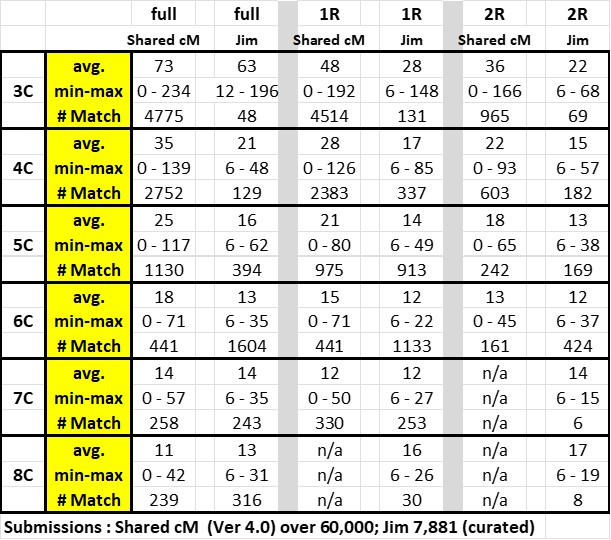
So let’s dive a little deeper. A lot depends on the mix of Matches that are being Clustered. In a perfect world we’d like to Cluster, say, only 3rd cousins (3C) – the resulting 8 Clusters (hopefully) would be 1 Cluster for each Great grandparent. The average for a 3C is 73cM, but a true 3C can range from 7cM to 234cM (per the Shared cM Project 4.0). The point is there is NO cM range that would only include 3C. And it only gets worse with 4C and beyond (and if you follow me – I go way beyond 4C). So: Live with it! We can take some measures to tighten up our Clusters as we Walk The Clusters Back (WTCB).

When we start with an 80 or 90cM lower threshold for a Cluster run, we usually get 4 Clusters, with one for each grandparent. These Clusters tend to follow the rule. But beyond that, with smaller cMs and more distant cousin-Matches, the randomness of atDNA comes into play. We can say the growing numbers of Clusters (as we lower the cM threshold) will tend* to a CA. But I use “tend” because it’s not a guarantee – it cannot be a rock solid rule – “the random DNA didn’t get the memo”.

So, can we have a Cluster using a Cluster run of 60-300cM have 2C, 2C1R, 3C, 3C1R, and 4C Matches in it? Absolutely! They should all be on the same line, but that brings up two important points.

1. Old saying: “Everybody has to be someplace”. The 60-300cM range covers all those cousinships (and more); and in Clustering, every Match “has to be someplace” – it will go into some Cluster! Some of the higher cM Matches (closer cousins) may well have gray-cell links to other Clusters. The way I think about it is that they are “confused” about which Cluster to be in – they are tugged in several directions – but the Cluster algorithm always picks one Cluster. My advice for these Clusters is to focus on the CAs of the smallest cM Matches in each Cluster – usually the most distant Matches – to determine the CA of the Cluster. Hopefully we’ll get a clear consensus (but remember Cinderella’s slipper).  The higher cM Matches in each Cluster often will have gray-cell links to other Clusters – this serves as a QC (Quality Control) check that the several Cluster CAs are related and appropriate. It also confirms these higher cM Matches are closer cousins, descending from all the CAs of gray-cell-linked Clusters.

2. It will also help to reduce the upper cM limit, to cull out some (but probably not all) of the closer cousins as the lower threshold is reduced in the WTCB process. These “closer cousins” have already “done their job” for WTCB. They have helped determine Matches who are one more generation back. In other words, your 2C Matches will help identify your 3C Matches (who have to be from one or the other of the 2C parents). At each Cluster run this information is imputed to the other Matches in their respective Clusters. This is not perfect – there will also be some 2C1R, 3C1R, half 3C, 4C1R in the mix. But it gives you a much better/tighter picture of the CA of each Cluster. These imputed/”tagged” 3C Matches will carry the ancestral thread to the next round of Clusters. Remember, going back in generations, there are only 2 possibilities in the next generation – the father or the mother. Reducing the upper cM threshold will cull out Matches that have already “passed on” their Ancestral line, and will force each new Cluster to group on itself.

The point is to make successive Cluster runs, lowering the thresholds each time to get more Matches, who tend to be a little more distantly related and will divide up into new Clusters which will be a little more distant. In each of these new Clusters there should be a mix of “old” Matches (from previous Clusters, some with known relationships, and some with imputed CAs), and “new” Matches (some with known relationships and CAs, and some unknowns which will be imputed based on analysis of all the Matches in the new Cluster).  

Note 1: Usually, I use CA to note the Common Ancestral Couple between myself and a Match. Clusters tend to form on specific Ancestors. Are they individual Ancestors or the parental couple? I’m not real sure. I will say that I rarely find a Cluster that I can identify solely to a female Ancestor. This makes sense because most of the time the husband/wife couple are together. So I will continue to use the male Ahnentafel number to describe my Cluster CAs.

Note 2: WTCB is a relatively easy process to start, but with each iteration it gets harder – both because of the approximate doubling of Matches at each step but also the inevitably difficult Cluster(s) to sort out (probably a brick wall). In any case you can start manually by just walking down your list of Matches in cM order and coding them (I’d use the Ahnentafel Number) and checking with their respective Shared Match lists. Stop whenever you want. (For me, the first two WTCB iterations were easy (a few hours); and then I worked on one a day for several more…. Your results will vary, depending partly on the amount of “Notes homework” you’ve already done.

Note 3: This is a great tool for bio-Ancestors, Brick Walls, NPEs, etc. Using this WTCB process will identify known Clusters. Some may leave you stumped (a few did for me). One reason you may be stumped is because you have no known/imputed Matches for a new Cluster – just Matches staring back at you with no clue how you are related. The WTCB Cluster comes to a halt. Now’s the time to examine all of the available Trees from the Cluster. If the Cluster Matches have their own CA, you have a BINGO! That’s probably your Ancestor, too. Check any gray-cell links to other Clusters to learn more about where in your Tree this could fit.

[19O] Segment-ology: WTCB Observations and Advice by Jim Bartlett 20231130

Triangulation and Clustering Among Companies

A Segment-ology TIDBIT

Bottom line up front: Triangulation and Clustering should have pretty much the same result at each company. This may allow imputing some Common Ancestors from Ancestry Clusters to the other companies and imputing some Triangulation segments from other companies to Ancestry Matches.

It may seem obvious, but it bears repeating. Your ancestry is fixed, static, unchanging. Your biological ancestors are determined at conception and cannot change. Your parents, grandparents, great grandparents, etc. remain the same no matter where you test.  Likewise, your DNA segments from Ancestors are determined at conception. These segments do not change throughout your life and are the same no matter where you test.

Therefore, the grouping methods we use should be roughly the same no matter where you test.

Your DNA segments don’t change. Segment Triangulation is based on your DNA segments. Each Triangulated Group (TG) is based on one of your DNA segments. A TG formed at any company would be the same specific segment at each of the other companies. In fact my DNA segment spreadsheet has 372 TGs formed from segments from all of the testing companies. The segments identified by each company “fit” into my TGs. There might be very slight differences among the companies, but the overall segments still fit only one way.

Your Ancestors don’t change. Take, for instance, the LEEDs method, which groups your 90-300cM Matches into four groups – one group for each of your four grandparents. No matter where you test, the four groups would be the same – one  for each of your four grandparents.

LEEDs is a special subset of Clustering. Clustering groups Matches on your Ancestors. Clusters should form on the same Ancestors, no matter which company is being used (Clustering depends on Shared Matches aka In Common With or Relatives in Common). It’s almost like a parallel universe at each company – for a given range of Match cMs, about the same Ancestor Clusters should result – based on your Ancestors. Clearly a Match who has tested at two or more companies, should show up in the same Cluster at each company. Maybe not 100 percent of the time, due to the vagaries of Shared Matching, but most of the time.

I need to try Walking The Clusters Back at each of the companies (at various cM thresholds) and see how parallel they are. I strongly suspect very strong concurrence with the larger Clusters, and large cM thresholds. Perhaps at some point, with lower cMs, the concurrence will drift away .To be continued…

Takeaway. We can Triangulate segments at 23andMe, FTDNA, and MyHeritage – giving each Match a TG for each shared segment. We can Cluster Matches at 23andme, FTDNA and MyHeritage, and note any concurrence of TG segments in these Clusters (usually one or a very few). We can determine some Common Ancestors at these companies. We can determine many more Common Ancestors at Ancestry (particularly out to 6C with ThruLines). We can Cluster at Ancestry and note any concurrence of Ancestors in these Clusters (there usually is one). Some Ancestry Matches have also tested/uploaded elsewhere, so we can determine their TGs. We can then compare Ancestry Clusters with Clusters at the other companies for congruence – allowing us to impute Common Ancestors to the Matches at other companies, and TG segments to Ancestry Matches. Maybe not in all cases, but probably in some cases.

[22BY] Segment-ology: Triangulation and Clustering Among Companies TIDBIT by Jim Bartlett 20231028