Another Take on Segment Triangulation

The segment Triangulation Mantra is: 3 separated cousins match each other on the same DNA segment – don’t use close relatives or segments below 7cM.

Besides the fact that this Mantra works, let’s back up a little bit and review why it works – what are we really trying to do. Well… we are really trying to insure all the segments in a Triangulation are from the same side – from just one of your parents. We have two of each chromosome – one from our mother and one from our father. We want our segment Triangulated Groups (TGs) to be on one just one of these chromosomes – to insure we are looking for a Common Ancestor on one side of our Tree (and to insure we don’t intermix the data from our two chromosomes to create a false segment in our TG).

What we want are shared DNA segments on only one of our chromosomes! On one side!

So…. What if we know some of our Matches are on one side – each one is definitely on our maternal or paternal side?  Our segment Triangulation becomes almost trivial. Overlapping segments on the same side are Triangulated.

If we have DNA tested a parent, we can relatively easily determine which Matches are on that side. For these, all that is required is segment overlap for Triangulation.

If our parents have significantly different ethnicities, we can often separate many Matches into maternal and paternal sides. Segment overlap with either side equals Triangulation.

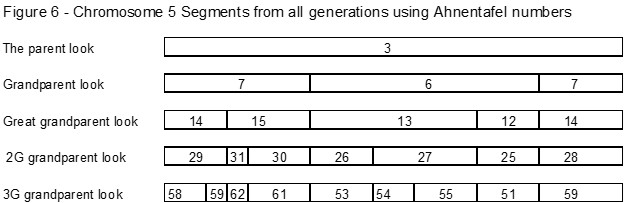
Shared Matching (ICW) groups which are clearly one side or the other allow Triangulation just by overlapping segments. This is my preferred method for Triangulation at FamilyTreeDNA (overlapping segments and clear ICW grouping/Matrix). A subset of this is to use the LEEDs method to determine the four grandparents (and thus maternal and paternal groups) and extend to many other Matches who clearly have a Shared Match (ICW) consensus on one side or the other. Use “dots” or Notes to indicate maternal or paternal (or both) sides – these indicators absolutely help identify the side for more Matches.

Clustering often results in Clusters which can be clearly identified as maternal or paternal – this usually applies to all the Matches in each Cluster (but use caution with endogamy).

Note in all of the above, absolutely include parents, aunts/uncles in the TGs! Children and grandchildren should not be included, unless you’ve done other, detailed, analysis on their segments – in general, your descendants don’t add any value except in rare cases when comparing across company lines.  

If in doubt – leave it out!  Our ancestry (and DNA) sometimes includes some twists and turns. If you come upon something strange, revert to original mantra and check the Match segments against each other.

Take away: If you are sure of the same side, overlapping DNA segments Triangulate.

[11E] Segment-ology: Another Take on Segment Triangulation by Jim Bartlett 20230910

Free DNA Classes from MITx

BLUF: MITx Course: Genetics: Population Genetics and Human Traits – Free Starts NOW!

Several years ago, I took their course: DNA – The Secret of Life; taught by Prof. Eric Lander – short bite-sized videos (some of which I watched several times); interspersed with a quiz; including labs and aside material – very close to a real life classroom experience – better than a Zoom (you can pause and rerun). Self-paced but covers a semester class. These MITx classes are available FREE! I highly recommend this class for anyone wanting to take a deep-dive into DNA. In one segment you’ll learn that the DNA base pairs are read in the 5 prime to 3 prime direction…

Link: https://www.edx.org/learn/biology-life-sciences/massachusetts-institute-of-technology-genetics-population-genetics-and-human-traits?utm_medium

[22BY] Segment-ology: Free DNA Classes from MITx TIDBIT by Jim Bartlett 20230816

We Match Segments, Not Matches

A Segment-ology TIDBIT

This is an important point: The DNA Matching algorithms are based on finding a Shared DNA Segment. My DNA Segment matches your DNA Segment. We say: I match you; but, technically what we mean is my DNA matches your DNA – our DNA segments overlap and match – they match enough to satisfy the algorithm.

Above 15cM, the matching algorithms are designed to determine an Identical By Descent (IBD) segment. My DNA is identical to your DNA (all the SNPs are the same) over enough DNA that it can only be that way because we both got that segment of DNA from the same Ancestor. This is the foundational concept of autosomal DNA testing.

If a person only shares one IBD segment with us, we call that person a Match. We match the Match. We are basically equating the Match to the Shared DNA Segment. And most of our “Matches” share only one IBD segment with us. But not all…

Some of our “Matches” share two or more DNA segments with us. In these cases, we need to be careful how we speak. Each of these Shared DNA Segments is an independent event. Most of the time, multiple Shared DNA Segments will be from the same Common Ancestor, but that’s not a requirement of the biology. From my spreadsheet of over 20,000 shared segments, I can attest that there are many instances of multiple segments from one Match coming from different Ancestors (as well as many instances of Matches who are genealogically related to me in multiple ways).

I raise this point because I found myself assigning my 3C Match with 6 Shared DNA Segments to our Common 2xG grandparents. That is, in my spreadsheet, I assigned all 6 segments to the same 2xG grandparents. Analyzing each of these resulting Triangulated Groups, I found one that was “off”, “strange”, “out of kilter”… The other Matches in that TG were related to me on a different line. A little investigation into my 3C’s Ancestry revealed we were also 7C on a different line.  

I also raise this point to illustrate the importance of segments in genetic genealogy.

The point here is that we don’t really “match” a Match, we only match a part of their DNA.

Notwithstanding… like most of us, I will continue to say that “I have a Match” and that “I match person A”. It’s just important to remember that part of our DNA matches part of our Match’s DNA.

[22BF] [ Segment-ology: We Match Segments, Not Matches TIDBIT by Jim Bartlett 20230813

Can Three Fourth Cousins Share the Same Segment?

Bottom Line Up Front [BLUF]: Yes, but caution.

Here is the original statement that prompted this blog post:

The chance that three fourth cousins will all share the same matching segment is practically zero.

A bold statement – repeated several times – that has implications for Triangulated Groups. It appears this was part of the education material provided by AncestryDNA for their DNA Circles feature [Hat Tip to Debbie Kennett – the material is no longer online].

This means you and two 4C Matches sharing the same matching segment [all three of you descending from 3 different children of the Common Ancestor].

Mitigating factors:

1. Shared DNA segments in a Triangulated Group (TG) are rarely “the *same* matching segment”. We are almost always talking about overlapping segments of different sizes. So that gives some wiggle room. Maybe the odds are just small (not practically zero) with a group of different sized segments in a TG.

2. As Debbie pointed out to me, these were simulations by Ancestry, using “perfect” data. In genetic genealogy our data is usually somewhat messier than simulated data, so there is even more wiggle room. Maybe the odds are on the low end…

3. Another factor is that the data has grown substantially since the simulations were done for the Circles feature. The information has been removed.

The bottom line for me becomes: If you find 4C Matches in one TG from more than two other children of the Common Ancestor, take a closer look at it. It is possible, but there may be other factors at play.

Segment-ology CONCEPT – For Matches forming a TG (overlapping segments in a range), the odds decrease with each generation going back and with each additional child of the Common Ancestor. Take a critical look within TGs beyond 3C Matches spread over more than 2 other children. The odds are very small with Matches from 3 other children (total of 4 children).  This is not a “rule”.

Important Note: This does not mean that we cannot have DNA Matches from 4 or more children. We can! Instead of a double negative let me say: We can have 4C Matches from more than 3 other children of the Common Ancestor – we can have 7C Matches from 5 other children of the CA. It just means that there is more than one segment (TG) involved.  Over the different children, we should expect to see several TGs. We can have over a hundred Matches in a TG going back to 7XG grandparents, for example. We just need to carefully screen for the number of children per TG.

Takeaway: It’s hard to have a hard “rule” on this subject. However, it makes sense to pay attention to our data. The further back we go (in generations), the more constrained our options become.

I’m inviting discussion on this Segment-ology CONCEPT, and on your experience with TGs and numbers of Common Ancestor children.

[08E] Segment-ology: Can Three Fourth Cousins Share the Same Segment? By Jim Bartlett 20230812

A Triangulated Group is an atDNA Haplogroup

A Segment-ology CONCEPT and Thought Stimulator

Per Wikipedia: A haplotype is a group of alleles in an organism that are inherited together from a single parent, and a haplogroup is a group of similar haplotypes. Your atDNA segment from an Ancestor is likewise a group (or string) of alleles (SNPs) that is inherited from a single parent – an atDNA haplotype. The Match segments in a Triangulated Group (TG) have this same string of SNPs – they have matching shared DNA segments – and this group would then be a Haplogroup (Hg).

A Triangulated Group of segments would be a Haplogroup.

Wikipedia also notes that in human genetics, the haplogroups most commonly studied are Y-Chromosome (Y-DNA) haplogroups and mitochondrial DNA (mtDNA) haplogroups, each of which can be used to define genetic populations.

In exactly the same vein, a Triangulated Group (TG) defines a genetic population. It’s the population of descendants who carry the same segment of DNA passed down by an Ancestor. DNA test takers in this population have shared DNA segments with the same string of SNPs – they match each other!

An mtDNA Hg is often many thousands of years old (because the mtDNA rarely changes). A Y-DNA Hg is usually somewhat closer, and with a Big-Y test, is often found within a genealogical timeframe. My estimate is that an atDNA Hg (a TG) is usually 5-9 generations old – generally within a genealogical timeframe. We could argue that a TG Hg is a better tool than Y or mt. For me, it is a very good tool. In any case, each DNA Hg tool has strengths in genetic genealogy.

Note that the process of Triangulation culls out most, if not all, false shared segments. A few false Match segments (under 15cM) may slip in; but your own DNA, as the base in a TG, is true. If such an under-15cM Match is critical to you, you need to check for Triangulation with that Match segment as the base.

MUSING….

Dr. Tim Janzen – one of the earliest pioneers in atDNA (and my early mentor), has often advocated for a database of unique atDNA segments from our Ancestors. I used to think of this as a giant TG database and wonder how we would describe each TG. Now I think it would be an atDNA Haplogroup database, but still wonder how we would describe each Hg. Each segment would be unique to a specific Ancestor and would be on a specific chromosome (with start and end points). Note the chromosome could be maternal or paternal, depending on each Match’s ancestry. This segment would manifest itself in a TG, with shared segments from other descendant Matches. Each Match would likely have his or her own unique TG. These TGs taken together would represent an atDNA Hg from that Ancestor.

NB: if we can phase our data, we could actually record the SNP alleles (ACGTs) in each TG (or atDNA Hg)! Alternatively, by comparing raw DNA data among the Matches in a TG, we could probably determine the individual the SNPs. Remember your TG segment is the equivalent of phased DNA.

This post is about an atDNA Haplogroup. It’s a concept to think about. Your thoughts are welcome here.

[14B] Segment-ology: A Triangulated Group is an atDNA Haplogroup by Jim Bartlett 20230802

Triangulation on a Side Is a Snap

When working with Matches on one side (Maternal or Paternal), segment Triangulation is a snap. Overlapping segments are all you need! The overlap should be at least 7cM, and more is better.

The basic rules to form Triangulated Groups, were designed to insure your overlapping shared DNA segments were on the same side – in other words on just one of your chromosomes. This means, from your viewpoint, the overlapping segments were both (or all) on your maternal *or* paternal chromosome. It didn’t matter which side it was on for your Match. You can have lots of shared segments on one chromosome, but some may be on your maternal chromosome and the others on your paternal chromosome. It is virtually impossible for Match A’s shared segment on your maternal chromosome to also match Match B’s shared segment on your paternal chromosome. So the requirement is/was to compare Match A and Match B to insure they match each other – and are thus on the same chromosome with you.  *IF* you already know Match A and Match B are on, say, your maternal side, then their shared DNA segments with you would be on your maternal chromosome, and there is no additional need to compare them to each other – they Triangulate.

I am sure, in the grand scheme of genetic genealogy, that an occasional glitch could occur. I’d estimate this as way less than 1% probability.

FTDNA has maternal and paternal buckets which appear to be pretty accurate. If the companies designated a “side” and allowed us to filter Matches based on that side, it would sure speed up segment Triangulation. Just look at a spreadsheet for natural crossover breaks in each chromosome.

In the meantime, if you can designate your Matches as Maternal or Paternal in some way (compare to a parent’s test, ethnicity, shared matches, etc.), you can use that info to filter your Matches and ease the segment Triangulation process. There’s still a lot of work to do, but this should ease the process some.

[10E] Segment-ology: Triangulation on a Side Is a Snap by Jim Bartlett 20230730

Triangulated Group Segments Are Like mtDNA

A Segment-ology TIDBIT

mtDNA is passed from a female Ancestor down the all-female line to each of us. A Triangulated Group (TG) DNA segment is passed down from an Ancestor to us. The concept of DNA being passed down a specific ancestral line – from an Ancestor to us – is the same. Such is also the case for Y-DNA – it is passed from an Ancestor down the all-male line to a man. In the case of mtDNA, the ancestral path is all females; in the case of Y-DNA, the ancestral path is all males; but in the case of atDNA, the ancestral path can zig-zag between male and female Ancestors. Any of our Ancestors could pass an atDNA segment down to us.

The point is the TG segment is found only on one specific ancestral line (like the mt or Y line). However, it is still a genealogy task to figure out which line. As we “walk the segment back” from our own DNA back up our ancestry, there are only two options at each generation. If we know a TG segment is on our maternal side, the next generation back must be one of the maternal grandparents – and so on.

Just as we use mtDNA or Y-DNA, looking for a someone who shares that same DNA with us, to find our Common Ancestor; so, too, we understand that our atDNA Matches in a TG (thus sharing that same atDNA with us) will have a Common Ancestor with us.  

This is just another way to think about our DNA segments – they are just as focused as the mt or Y on *one* ancestral line.

[22BX] Segment-ology: Triangulated Group Segments Are Like mtDNA TIDBIT by Jim Bartlett 20230728

Getting ThruLines to Work for Me

A Segment-ology TIDBIT

Here is the set up for my BROWN story, without dragging the reader through the whole back story. This line includes most of the descendants in the BROWN Y-DNA Project Group-40.

I’m searching for the children of Wilson BROWN (he probably had 10 children, only two daughters are known). This is my Tree at AncestryDNA. I expected ThruLInes to find some Matches… Nada. I had Matches from Keziah (and her husband Elliott BAKER) on down. I had none from Wilson – not too surprising because no one has any Trees for Wilson (except for daughter Keziah). I expected some 6C Matches from James, because I know they are out there – but… nothing.

So I used my “Search on a Surname” process [here] – I searched for the BROWN surname, and checked each Match’s Tree for likely families. One family that quickly became the standout was the family of Thomas BROWN 1773 married Nancy LITTON. I was getting a lot of “hits” on that family. So, I looked them up at Ancestry – there are 2,668 Trees for that line! Almost everyone who shows his parents, has John/James BROWN b 1731 MD; married 1755 Plymouth, MA; d VA & Sarah LITTLE b 1737 VA; d 1779 VA.

Two key points about Thomas BROWN 1773:

1. I have found over 70 Matches who descend from Thomas BROWN b 1773 (shared DNA segments from 10 to 30cM). These are spread over virtually all of his children.

2. Two descendants of Thomas BROWN 1773 – through different children – have taken a Y-DNA test and are in BROWN Group-40. So, Thomas BROWN 1773 is BROWN Group-40. No one else in Group-40 has claimed descent from his father, John BROWN 1731.

I have concluded that Thomas BROWN 1773 must be a son of Wilson BROWN and so I added him (and his children) to my Tree.  I stand alone in doing so…

I waited over a month for Ancestry’s ThruLines to show me the 70 Matches I had found – nada. Disappointing… Ancestry clearly had Thomas BROWN 1773 locked onto John BROWN 1731. I’ve written at least 10 blog posts about the power and usefulness of ThruLInes – search for links to them in the Segmentology Outline [here]. One post is about ThruLines X-Ray vision looking into Private Trees…

So, I decided: maybe Ancestry is correct! Maybe if I accepted their version, ThruLInes would report some of my DNA Matches as cousins. So, I changed my Ancestor Keziah BROWN from the daughter of Wilson BROWN to the wife of Thomas BROWN 1773 (so the two of them looked like the parents of my ancestor, John Brown BAKER – almost like Thomas had an affair with Keziah.)

The next day Ancestry listed 31 new ThruLines Matches (spread from 6 to 30cM) – all descending as half-cousins from Thomas BROWN 1773 – WOW.  All of these were new to me. 2xWOW! Near the top of the list was a Match with a Tree with only 2 parents, and 3 grandparents – ThruLines built the Tree back to Thomas 1773. I have built a lot of Quick&Dirty Trees in my BROWN searches, but I would not have tried that one. 3xWOW! And another Match had a Private (but searchable) Tree. I’d never have found that one. 4xWOW!

The fact that I adopted the on-line version of BROWN Tree does not detract from my goal: find more DNA Match cousins from Thomas BROWN 1773. And ThruLines delivered.! The Matches share DNA with me (no matter how the Tree is drawn).

I still need to put all of these in a spreadsheet; make sure they are reasonable; figure out the averages and see how they compare to the Shared cM Project. And I’ll wait a few more days – fully expecting another tranche in the next day or two.

BOTTOM LINE:

This method will sure save a LOT of scrolling through all the thousands of 8-9cM Matches for BROWN Matches (it took me over a Month of steady focus to just get through the 10cM BROWN Matches). And it will find cousins with Private Trees and cousins with very small Trees that don’t have BROWN in them!

[22BW] Segment-ology: Getting ThruLines to Work for Me TIDBIT by Jim BARTLETT 20230707

Identifying False Shared DNA Segments

A Segment-ology TIDBIT

I contend that segment Triangulation will identify most of the false shared DNA segments reported from your DNA test. This includes a Match with one segment which is false; as well as a Match with multiple segments, some of which are false. I have Triangulated DNA segments at FTDNA, 23andMe, MyHeritage, and GEDmatch, and found many false segments (segments which did not Triangulate with other overlapping segments). In almost all cases these false segments are under 15cm. I cannot guarantee that all the false segments can be identified this way, but I am confident that most can. Triangulation is a time-consuming process – starting with a download of all your segments from one company at a time; sorting them by Chr and Start, and then working down the list to see which ones Triangulate. I did a blogpost using MyHeritage as an example for segment Triangulation: https://segmentology.org/2020/12/29/triangulating-your-genome/

Warnings: this takes weeks; there are some Triangulations that are difficult – just skip over these; a few might slip through the cracks; there may be some bare spots in your DNA.

Special Note: Although a Match’s segment(s) may be false, that does not mean the Match is not a cousin. This looks like a double negative, so let’s phrase it this way: a Match may be a cousin and not share any DNA segment with you, or they may share a false segment with you. In fact, about half of your true fourth cousins (4C) will not share a DNA segment with you.

Recently, at the Genetic Genealogy Tips & Techniques facebook group, there was a post looking for ways to identify Matches at MyHeritage which are random junk. Segment Triangulation would identify a lot of false segments. However, at MyHeritage, it might be efficient to just download all segments, focus on those below 15cM (where most false segments would be) and work down the list to see which Match segments don’t have a TG Icon. Still a lot of work… If anyone tries this, please post about your experience – we can learn from each other. 

[22BV] Segment-ology: Identifying False Shared DNA Segments TIDBIT by Jim Bartlett 20230618

A Means To An End

A Segment-ology TIDBIT

I have long been a proponent of segment Triangulation (and Triangulated Groups (TGs)) and also Shared Match Clusters. Both of these are powerful tools. Both TGs and Clusters group your DNA Matches who share the same Common Ancestor (CA) with you.

But this is just a means to an end. By themselves these groups (TGs and Clusters) do not magically name an Ancestor, they point to a specific, but unnamed, Ancestor. They are just groups of Matches. We must also use genealogy!

By analyzing the Trees of Matches in a TG or Cluster, we can often find a consensus Ancestor. This Ancestor may be a known ancestor, and the Matches’ Trees may provide additional information for our research. Alternatively, this Ancestor may be a new Ancestor for us – a bio-Ancestor, a Brick Wall Ancestor, or even a “floating” Ancestor (unknown connection to our Tree). Or perhaps a fluke, a coincidence, a curve ball from our DNA Matches.  Although a fluke is possible, as you research this new “ancestor” more, it either becomes more and more probable as your Ancestor, or less and less likely. In my experience, the evidence usually starts to mount . In only one instance for me did it pretty quickly fall flat (and in that case, I found a “secondary” consensus Ancestor in the group which worked out). As usual, treat this “consensus Ancestor” as a good clue.

Another way to frame this is: TGs and Clusters are good tools – more genealogy work is needed to make them useful – to find out more about your Tree.

The point of this TIDBIT, is that forming TGs and Clusters are good processes, but they are only a means to an end. IMO, they are definitely a step in the right direction, but the research journey is not over with that step. We need to take the next, genealogy, steps of analyzing the groups to find the CA and then integrating that information into our own genealogy.

BOTTOM LINE: TGs and Clusters are a good step – analyzing these groups is an essential next step.

[22BU] Segment-ology: A Means To An End TIDBIT by Jim Bartlett 20230611