

Part 1 of this topic covered some of the background of how TGs are distributed over our Ancestors. This post is about where Triangulate Groups (TGs) are formed and their journey from the Common Ancestors (CAs) down to us and our Matches.
Recap of Part 1:
-Rule #1: We can expect roughly the calculated numbers of TGs from each generation – an order of magnitude
-Rule #2: We can expect about 34 crossovers to occur per generation on each side.
-Rule #3: Shared DNA (with Matches) reduces by roughly 1/4 with each generation.
-Rule #4: We should not see Matches (over 3C), with the same TG, descending from more than two children of a CA
-Rule #5: The amount of DNA, and number of TGs, are not affected by external factors.
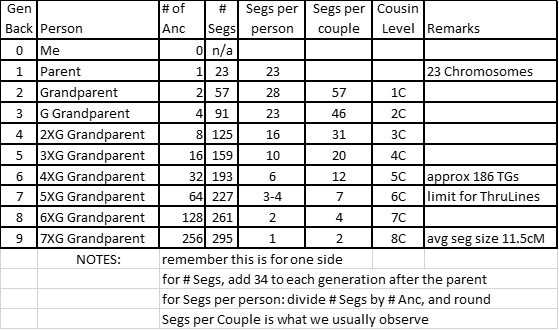
-I have 372 TGs, roughly 186 per side, which is close to the 193 TGs predicted to come from my 16 4xG Grandparent couples (6 generations back – 5C level) on one side – about 12 TGs per couple. [See the table in Part 1]
The musing continues…
The TGs we eventually get were in our Ancestors’ DNA somewhere.
Think about the Ancestor who first formed (through recombination) the DNA segment that finally came to you as a TG segment. That Ancestor passed a whole set of Chromosomes to the child who was also your Ancestor – and that TG segment was included somewhere in all those Chromosomes. In these distant Ancestors the TG segment was probably part of a somewhat larger segment. With each succeeding generation that larger segment was either subdivided by a recombination crossover or passed along intact. The smaller the larger segment got, the less likely it was to be subdivided. Near the end of its journey, the TG segment was passed from a parent down to you.
Which Ancestor forms a TG?
Which Ancestor first formed the TG? The most distant cousins, who share the full TG segment, determine the Ancestor. If four 5C all share almost all of the TG segment, then that segment probably came from a 4xG grandparent. NB: 6C and 7C can also be in this TG (usually sharing only a part of the TG segment); and 3C and 4C can also be in this TG (but they aren’t the most distant); and 1C and 2C may actually share this TG and an adjacent TG. It’s often hard to get enough good cousins in a TG to nail it down with certainty.
All TGs from an Ancestor, come through one* child to you.
If an Ancestor couple is “responsible” for 12 TGs, all 12 of those TGs must come down through the one* child (usually) who is our Ancestor. The DNA is also coming from our Ancestor couple down through other children of the Ancestor couple and then down to our DNA Matches.
[*It is possible that we descend from two (or more) children of an Ancestor. If so, each one is treated independently. If an Ancestor at this level was passing down an average of 12 TGs (see the table in Part 1), then that Ancestor would need to pass down roughly 12 TGs to each child who was our Ancestor. Siblings share some DNA with each other. So, some of the TGs could be shared, some would be different. A single child is used to illustrate the concepts in this blogpost.]
All TGs from an Ancestor (MRCA), come through other children to our Matches.
Take an Ancestor couple with two children – all TGs pass down through the one child who is our Ancestor to us; the same TGs also pass down through the other child to our DNA Match-cousins. If an Ancestor has three children, again all TGs pass down to us through the one child who is our Ancestor, and those same TGs could be split between the other two children. If an Ancestor has multiple children, the TGs could be distributed over those other children with two concepts at work: 1) not every child has to get and pass on a TG; 2) The same TG cannot be passed down through more than 2 different children (Rule #4). [An Ancestor couple with only one child is trivial – all TGs pass down through the one child to us, and we have no Match-cousins from this Ancestor].
Amount of DNA vs Number of Matches
It appears to me that roughly the same amount of DNA (TGs) should come from our Ancestors in a large family as from a small family (review Rule #5). Each Ancestor has the same chance of passing DNA down to us as another of our Ancestors (and all of that DNA must come to us through just one of their children – usually). The amount of DNA (and number of eventual TGs) would not depend on the number of children that Ancestor had. But the number of Match-cousins we get would be influenced by the number of other children, and subsequent descendants, they had (and other Rule #5 factors). You might get the sense that I’m trying to emphasize this point – maybe because it’s hard for me to realize that I get the same amount of DNA (in TGs) from an Ancestor couple with few children as I do from one of my Ancestor couples with very large families.
Over the past 45 years I’ve determined over 20,000 descendants of my BARTLETT Patriarch – they were farmers with large families. I do find many Matches with MRCAs, but they all seem to be on repeating TGs (or Clusters). With this paragraph, I now understand why. Each of our 64 4xG grandparents (on both sides) will pass down to us an average of 1/64th of our DNA. Experience and random DNA shows this is not exact, but it is a good order of magnitude – each 4xG grandparent will have a little more or a little less than 1/64. However, the sum of all 64 4xG grandparent contributions to our DNA will total exactly 100%. This leads to Rule #6:
6. The sum of the DNA contributions of all Ancestors at each generation will be 100%. You can take this one to the bank. At each generation, all of our Chromosomes will be filled with DNA from the Ancestors in that generation. I wanted to say our Chromosomes will be filled with TGs from the Ancestors in one generation, but that would not be technically correct. Some of that DNA may be small segments that would not form a TG. But in a closer generation those small areas are recombined into larger TGs. Clearly, from a parent’s generation we get full chromosomes – no small segments…
TGs “accumulate” in closer Ancestors
Let’s assume my 4xG grandparent couple passed down 12 different TGs – to me and our some of my 5Cs. Because the 5Cs have those TGs, we know the TGs existed in a 4XG grandparent. All 12 of these TGs were passed down through the child that was my Ancestor, as discussed above. That child married a child of another 4xG grandparent couple who also passed down about 12 different TGs to their child who was my Ancestor. This means that this 3xG grandparent couple must have 24 different TGs to pass down through one of their children (my Ancestor). Remember this 3xG grandparent couple will pass down a lot of DNA to their child (46 Chromosomes) – that DNA will include at least those 24 TG-segments. At each generation, the die is cast, so to speak! These 24 different TGs must be passed down through their one child who is my Ancestor (in my line of descent), and on down me. After all, I have each of these 24 TGs. These 24 TGs are part of my “inventory” of 372 TGs that my parents passed to me in my Chromosomes. This reinforces the point that each TG is a segment of DNA that is passed from an Ancestor down to me; and each closer generation has to have all of the DNA (TGs) that their Ancestors passed down to me. This is also the reason a close cousin may well share a single DNA segment that spans more than one TG. As well-known examples: each parent passes down to us a full set of chromosomes that are full of TG segments; each grandparent passes down few, but generally large, segments which are also full of TGs. This leads to Rule #7:
7. Each Ancestor will have all of the TG-segments their parents had.
Recombination.
To backtrack a little, think about a DNA segment that a 4xG grandparent Ancestor passed down that was a recombination of segments from his/her two parents. Analysis depends on which generation we are looking at. A 6C (one generation back, on one of the two 5xG grandparents) would only see one segment or the other in an eventual TG. The same for a 5C, who would only be related through a segment on one chromosome (side) or the other (unless the 4xG grandparent created the same crossover in the DNA he/she passed to another child – a very low probability). A 4C (on the 3xG grandparent child of the 4xG grandparent couple), would see the recombined segment as a “regular” segment (on one chromosome), which could be passed down to two children and wind up as a TG. This is another reason why some TGs look like they split going back. This leads to Rule #8.
8. A TG that subdivides going back, separates into a two smaller segments – one from each parent.
To summarize this musing: clear back to my 8xG grandparents (and probably more distant), DNA segments are formed which are passed down to a child who is my Ancestor (as well as to other children who are the Ancestors of my Matches). It’s hard to pinpoint the exact Ancestor who first formed the DNA segment represented by my unique TGs. But from that point on down to me, that unique TG must be in that Ancestor, in the child, and in every other descendant down to me. Now, this child marries another of my Ancestors in that generation who is carrying the DNA with other TGs. So, this couple (in that next generation down) has roughly twice the number of DNA segments (that that will form into TGs) to pass to the next generation. Repeat generation after generation. Finally, my two paternal grandparents will pass roughly 193 segments to my father. To be sure, they only pass 57 segments to my father, but those 57 relatively large segments, will include all 193 segments that wind up in my TGs.
We got the TG segment from an Ancestor; each Match got an overlapping segment.
NB: When I say TG-segments pass down from Ancestors to us and our Matches – let me be clear. The TG represents a real, phased, segment of our own DNA. The shared DNA segments that make up the TG are an overlapping part of our DNA that our Match also has. Each Match may have a different overlapping segment with us. The DNA the Match got from our Common Ancestor may be larger or smaller than the TG-segment we got.
Part 3 will look at conclusions (what can we learn from all of this), and propose a two new spreadsheets to track TGs (what we can do!).
[15I] Segment-ology: Distribution of TGs – Part 2 by Jim Bartlett 20211005


 segment-ology